Red Raven UAS Weekly Briefing: Ontario Bans Chinese Drones, the Pentagon's $500M Counter-Drone Deal, and Dallas Launches Drone First Responders (May 22, 2026)
In This Episode
You call 911 — and a drone gets there before the patrol car does. That's not a concept video. That's Dallas, this week. It was a big seven days in drones, and the stories all point the same direction.
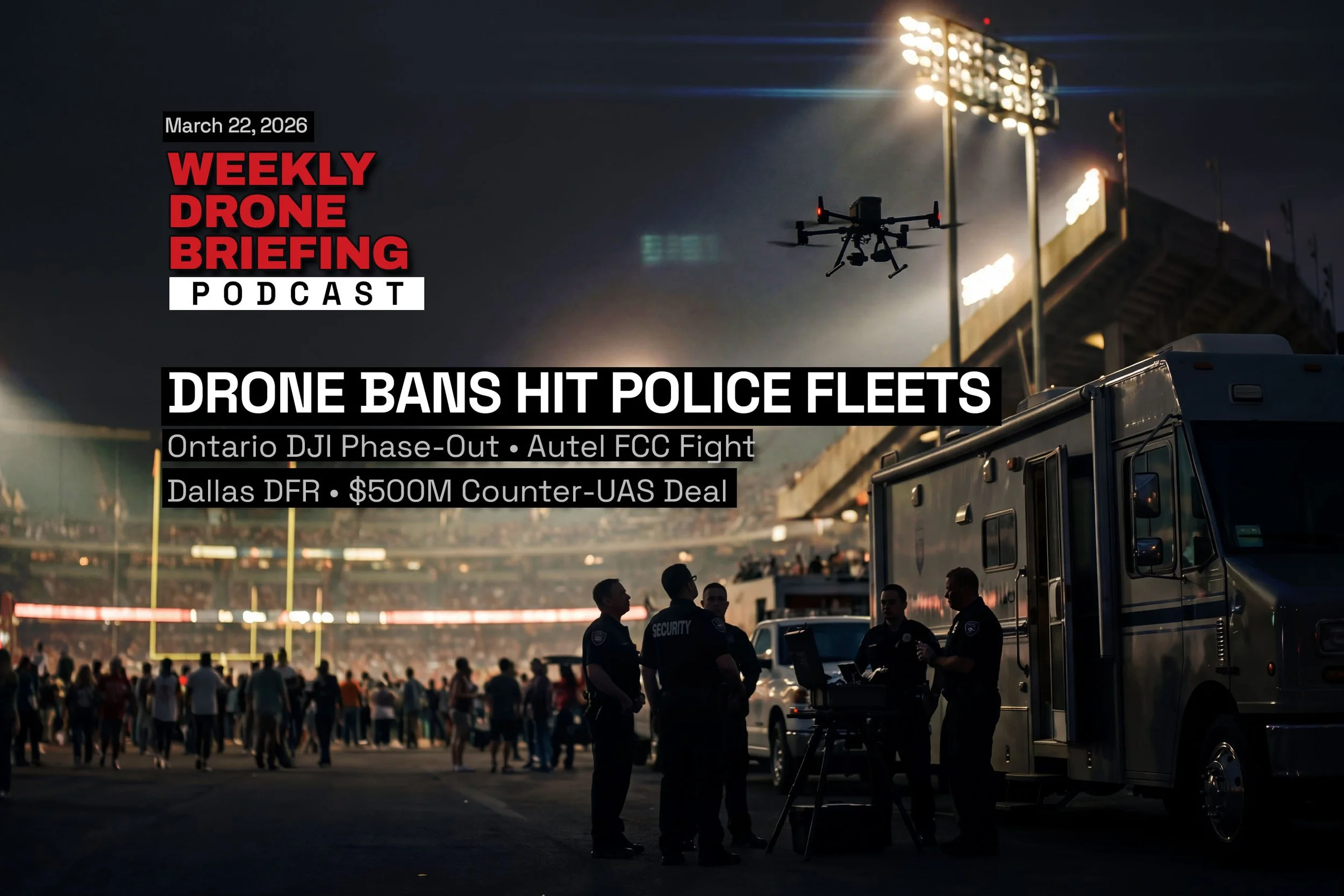
What you'll learn:
Why Ontario just banned Chinese-made drones — and what it means if you fly DJI
Autel's new fight with the FCC, and why drone makers are splitting apart
The Pentagon's up-to-$500 million bet on drones that hunt other drones
How Dallas built a Drone as First Responder program with 2-minute response times
Drone delivery going mainstream — from Taco Bueno to Amazon Prime Air
Kansas City's first-of-its-kind World Cup drone defense network
What it all means for agencies, operators, and anyone getting into drones
Chapters
00:00 Opening: The Sky Is Not Empty Anymore
02:34 Ontario’s DJI Ban and the Data Security Fight
06:57 Pentagon Counter-Drone Contract and Interceptor Economics
10:31 Dallas Launches Drone as First Responder
13:33 Kansas City’s World Cup Drone Coordination Plan
16:37 Zipline, Taco Bueno, and Amazon Prime Air Delivery
19:48 The Unified Airspace Stress Test
20:59 When Your Backyard Becomes Public Airspace
21:36 Closing and Red Raven CTA
Links & Resources
Red Raven UAS On-Site Training: redravenuas.com/services
FAA Part 107 Course: redravenuas.com/part107
Consulting & Program Development: redravenuas.com/services
Blog Post: http://redravenuas.com/blog/2026-05-22-weekly-briefing
For UAS consulting, on-site training, and FAA Part 107 certification, visit redravenuas.com
-
The Sky Is Not Empty Anymore
Imagine a, well, like a $15,000 piece of plastic and metal just slamming into a $2 million missile in midair. Right, completely neutralizing it. Exactly. Or, you know, picture a 911 call, where a flying triage nurse arrives at your front door to assess a medical emergency two full minutes before the first police cruiser even gets through the traffic light at the end of your street. Which is wild to think about. It really is. So if you think the sky above your head is just empty space waiting for clouds and commercial jets, it is definitely time to rethink that. Because the airspace above our cities, it just, it isn't empty anymore. No, not at all. It is rapidly becoming the newest, most heavily funded, and heavily regulated infrastructure grid on Earth.
Welcome to the Red Raven UAS podcast. Before we jump in, for anyone joining us for the first time, I just want to quickly say who we are. Red Raven UAS provides customized drone training, program development, and expert consulting. At Red Raven, we work with public safety, utilities, and enterprise teams. And our focus is really on one thing, helping you launch and grow a drone program that's safe, compliant, and actually ready for your mission. We do the consulting, the strategy, and the hands-on training that turns an idea into a real operational tool. Visit redravenuas.com for consulting, training, and FAA Part 107 certification. And check out the current special pricing on our Part 107 course.
Today we're taking a stack of intelligence from just this past week, five major developments that, honestly, they might seem totally disconnected at first glance. But they really form a perfect map of this new reality. And yeah, we are moving from a period where drones were treated as consumer electronics or localized tools into an era where they are this continuous, integrated logistical layer. It really is a fundamental rewriting of how we use the physical space above our rooftops. Yeah. And our mission today on the Red Raven UAS podcast is to connect the causality between these events for you. We're looking at sweeping geopolitical hardware bans, the Pentagon dropping hundreds of millions of dollars on kinetic interceptors. Massive shifts in local 911 dispatch, too. Right.
And the World Cup's counter-drone shield, plus the commercial delivery systems that are kind of stress testing all of this. We want to unpack not just what is flying over your head, but the actual mechanics of how this new airspace operates. And the throughline here is vital. You really cannot understand local public safety drone programs without understanding the military technology is shaping the regulation. Oh, sure. And you can't understand the commercial delivery market without understanding the geopolitical fight over the hardware. Every single piece dictates the rules for the next.
Ontario's DJI Ban and the Data Security Fight
Okay, so let's start with the base hardware and this huge legislative battle over who actually builds it. Just this week, Ontario, which is Canada's largest province, announced a complete phase out. Yeah, that was a big move. A massive move. They are stopping provincial police from using any Chinese-made drones on sensitive operations, specifically targeting DJI. And I mean, anyone following this space knows DJI is just the absolute behemoth, right? Oh, absolutely. They are the default platform for the vast majority of North American enterprise use. But Ontario isn't acting in a vacuum here. Florida actually initiated similar bans back in 2023. The RCMP, so Canada's national police, they did it in late 2025. And around that same time, the US Federal Communications Commission added DJI to a national security restricted list.
Which is huge. Yeah. We are even seeing Autel, which is another foreign manufacturer, aggressively fighting the FCC right now just to avoid being caught in that exact same regulatory dragnet. It really is a sweeping geopolitical squeeze. But before we get into the mechanics of why this is happening, we should be incredibly clear about our lens here for the listener. Yes, absolutely. Just to be clear upfront, we are not taking any geopolitical sides here or endorsing any political stance. Our goal is simply to impartially report the legal rationale laid out in these legislative texts so you understand the underlying mechanism driving the bans. Exactly. We're just looking at the facts. So what is that core legal rationale? It really comes down to data jurisdiction and telemetry architecture.
So under Chinese law, specifically the national intelligence law, the government can legally compel Chinese companies to cooperate with state intelligence operations and hand over data. Okay, but what if the data isn't in China? Well, the Western legal argument is that this applies even if a company's data is stored on servers located internationally. The jurisdiction follows the company, essentially. So the concern isn't necessarily a physical threat from the hardware itself. It's the data exhaust. Right. Let's break down how that vulnerability actually functions in the real world for you listening. If a local fire department flies a DJI drone over a burning chemical plant to map the structural integrity, how does that data actually get compromised? It comes down to how modern drones process information. They aren't these closed-loop systems anymore.
A commercial drone is constantly logging highly sensitive telemetry. Like what? We're talking precise GPS coordinates, altitude, high-resolution optical video, thermal mapping, and radio frequencies. And for operational convenience like fleet management or building 3D models, that data frequently syncs back to cloud servers. Right, because you need to access it later. Exactly. So the vulnerability Western governments are citing is that once that geographic and operational data hits a server owned by a foreign company, the legal mechanism exists for a foreign government to demand access to it. Which basically creates a systemic map of critical infrastructure. Exactly. It's the difference between malicious intent and legal vulnerability. The legislation isn't accusing these manufacturers of actively spying today. It's identifying that they could be legally forced to do so tomorrow.
Right, but let's look at the immediate reality for a listener who maybe manages a fleet of these drones for your university or a construction firm. I mean, nobody is showing up to confiscate your hardware this afternoon, right? No, no. The fleets aren't being grounded today. But the long term economic reality is shifting violently. How so? Think about how municipal budgets work. If you are a local agency or an enterprise heavily reliant on federal or state homeland security grants, you are essentially watching the funding tap for foreign-made hardware being permanently welded shut. Ah, I see. It's like finding out the brand new fleet of company cars you just bought might be permanently grounded by a sudden change in local zoning laws.
You can still drive them today, but you'd be foolish to buy another one tomorrow. Precisely. That's a perfect analogy.
Pentagon Counter-Drone Contract and Interceptor Economics
And this anxiety over invisible data leaks naturally pushes us toward the next problem. Right, the physical side. Yeah, if governments are desperately trying to legislatively ban the invisible threat of rogue data, how are they physically handling the threat of rogue hardware actually flying into restricted airspace? Which moves us from the legislative fight to the literal physical battle in the sky. So the Pentagon just committed to a massive contract, a ceiling of up to $500 million. That's half a billion. Yeah, half a billion dollars. With a California startup called Perennial Autonomy. And fun fact, they were founded by former Google CEO Eric Schmidt. And their approach to this problem is just fascinating. They are building these small, incredibly fast interceptor drones designed to physically smash into and disable hostile drones.
Kinetic drone on drone interception. It sounds like sci-fi. It really does. But we have to look closely at that $500 million figure because the underlying economics dictate why this matters. This is an IDIQ contract. Meaning indefinite delivery, indefinite quantity. Right. So it's not a giant check handed over on day one. It operates more like a pre-approved credit limit over three years. The military orders what they need up to that ceiling. But the real story here is the unit economics. One of these Perennial Interceptors costs about $15,000. Which is where the math totally flips. I mean, in traditional modern warfare, you have scenarios where militaries are firing a $2 million Patriot missile to shoot down a hostile drone that costs maybe $20,000 to build. Yeah, the math is brutal.
You don't need a math degree to see how quickly that bankrupts a defense budget. It is entirely financially unsustainable. The adversary wins simply by forcing you to spend your expensive inventory on their cheap decoys. What Perennial represents is a structural shift cheap defense finally beating cheap offense. But how do these things actually work? Because at the speeds these are traveling, human reflexes are useless. How are they actually ensuring a kinetic impact? Does it drop a net or use explosives? Neither, actually. It's essentially a smart blunt force object. Really? Just a battering ram? Yeah. The Interceptor uses advanced computer vision algorithms in its terminal phase. A human operator might get it to the general vicinity using radar tracking. But in the final seconds, the drone's onboard optical sensors take over.
Oh, wow. It identifies the target, calculates the trajectory of a jinking, evading, hostile drone, and micro adjusts its own rotors to physically ram it high-speed, completely destroying the target's rotors or chassis. And this scale is just staggering when you pair it with the other defense story from this month. Northrop Grumman was just named a preferred provider for a totally separate $1 billion program called Drone Dominance, where the Pentagon wants to field 200,000 drones by 2027. They are aggressively scaling the sword and the shield simultaneously. Right. But here is the critical connection for you, the listener. You might wonder why a civilian should care about a Department of Defense IDIQ contract for kinetic interceptors. It matters because the rules of the road are always written by the heaviest trucks.
The military drives the standard. Always. The counter-drone technologies being built for the battlefield require absolute electronic visibility. I mean, if the military is filling the sky with autonomous interceptors, they demand a system where every friendly drone constantly broadcasts a highly secure encrypted transponder signal to avoid being accidentally shot down. That makes total sense. And that exact requirement for electronic visibility is what the Federal Aviation Administration, the FAA, will inevitably adapt for domestic civilian airspace.
Dallas Launches Drone as First Responder
That is the perfect pivot point, because that exact military-grade transponder concept is the master key to unlocking our own municipal skies. If you can reliably track friendly drones, you can safely deploy them over crowded cities. Which is exactly what's happening. Yeah. We are seeing that happen right now. On May 20, the Dallas Police Department officially launched its drone as First Responder Program, or DFR. Dallas is a massive milestone for this technology. And the mechanics of how they are doing it are brilliant. These aren't police officers standing on a sidewalk holding a controller. No, not at all. When a 911 call drops, a drone is deployed simultaneously from specialized docks located on the roofs of eight fire stations across the city.
They are piloted entirely remotely from a central real-time crime center. They can cover a two-mile radius in about two minutes. And they're equipped with thermal imaging and loudspeakers. Just think about the physics of urban response times. Two minutes is vastly faster than a two-ton police cruiser can navigate through dense Dallas traffic, stoplights, and pedestrians. Yeah, I look at it like sending a flying triage nurse. Instead of an officer rolling in blind to a chaotic, potentially dangerous scene, say a reported armed robbery or domestic dispute, the drone gets there first. It provides an immediate God's eye view. And the tactical value of that view changes the entire outcome of the dispatch. How so?
Well, the drone's optical zoom can instantly confirm if a suspect is actually holding a firearm or if it's just a cell phone. It can track a fleeing vehicle without initiating a high-speed, dangerous pursuit through a residential neighborhood. Right, which saves lives. Exactly. Or, crucially, it can clear a false alarm without a human officer ever needing to draw a weapon or escalate the situation. Dallas is the ninth largest city in the United States. This isn't a niche pilot project in a small county anymore. This is DFR officially crossing into the mainstream. But looking at the implementation, buying the hardware seems like the easiest step. Oh, the hardware is just a line item on a budget. It's the easy part.
The actual friction, the barrier to entry for any city attempting this, is the bureaucratic and social engineering required to build the program. You're talking about the regulatory legwork. Regulatory and community. To operate a centralized DFR program where drones launch automatically, you need complex waivers from the FAA to fly over moving vehicles and people. You need deep integration with your computer-aided dispatch or CAD system. Right, so the systems talk to each other. Exactly. When a dispatcher types the incident notes, the software has to automatically geolocate the address and calculate the optimal flight path for the drone before the human dispatcher even finishes the call. That's incredible. But beyond the software, you need rock-solid, transparent policies regarding data retention and privacy.
If a community believes these drones are just persistent surveillance platforms peeking into backyards, the public trust evaporates and the program gets shut down by the city council before it ever scales. Definitely.
Kansas City's World Cup Drone Coordination Plan
So assuming a city gets that buy-in, and you have these DFR drones crisscrossing the skyline responding to emergencies, it introduces a massive air traffic control problem. Huge problem. Right. If a city is hosting a massive, crowded event, how on earth do authorities keep track of their own emergency drones, news helicopters, and potentially hostile rogue drones all at the exact same time? Well, that is the exact challenge being solved in Kansas City right now, and it really serves as the blueprint for the civilian shield. Okay, let's break down what's happening there. The FIFA World Cup kicks off on June 11, and Kansas City is hosting six matches at Arrowhead Stadium.
To handle the airspace, they've activated a fully integrated drone coordination platform partnering with local police and a tech company called Airspace Link. Their goal is to pull all these disparate pieces of drone detection gear into a single unified screen. The technical hurdle they are overcoming here is fragmentation, because traditionally, stadium airspace defense is just a mess of incompatible hardware. How bad is it? It's bad. The stadium security team might deploy radio frequency scanners looking for the controller link of a drone. The local police might bring in acoustic sensors listening for the specific hum of drone rotors. And then the FBI or federal agencies might roll up with traditional radar that bounces waves off the physical mass of the drone. And none of these systems speak the same language. Exactly.
They are proprietary. So what Airspace Link is doing is essentially building an API gateway like a universal translator. It takes the radio frequency data, the acoustic data, and the radar data, processes it, and fuses it into a single pane of glass. Responders get a comprehensive real-time map of the sky. And the operational advantage of that fusion is instant triage, right? Because if you are sitting in that command center, you can look at the screen and immediately differentiate between a clueless hobbyist who accidentally flew their DJI into the stadium restriction zone and made a cool photo. Right, which happens all the time. Yeah. Versus a coordinated threat using a custom-built drone that is actively trying to spoof its GPS or mask its radio signal. Exactly.
It separates the noise from the threat. But here is the real takeaway for the listener. And I think it's the hidden genius of how municipal infrastructure actually gets built. The most important detail isn't that Arrowhead Stadium will be safe during a soccer match. No, that's just the catalyst. Right. It's that this massive integration funded by federal homeland security grants designed specifically for the World Cup. It's a permanent capital injection. Yes. Mega events like the World Cup or the Super Bowl are effectively being used as Trojan horses to secure federal funding for permanent citywide airspace architecture that a local municipality could never afford on its own municipal budget. It's brilliant, really. It is.
When the tournament ends and the fans go home, that multi-million dollar sensor network doesn't get packed up in a box. It stays active. It becomes the permanent tracking grid that supports local DFR programs, like the one we just discussed in Dallas, for decades to come.
Drone Delivery Becomes Infrastructure
Which brings us to the final critical layer of this airspace puzzle. Governments and police forces are building this permanent tracking infrastructure. But commerce is actively paying to play in that exact same airspace. Private capital is cementing drones as a permanent logistics layer. The era of delivery as infrastructure. We saw two massive developments in commercial logistics just this week. Taco Bueno partnered with a company called Zipline for North Texas drone deliveries. Tacos from the sky. Tacos from the sky. Starting in Watauga and expanding to Frisco and Mesquite with more locations slated for 2026. And simultaneously, Amazon Prime Air announced it is launching in Baton Rouge this summer, carrying packages under five pounds within a seven and a half mile radius.
Yeah, we've been subjected to drone delivery PR stunts for a decade now, right? Seriously, so many test videos. But these are localized operational realities. However, to make a seven mile delivery radius function legally and physically, these companies have to overcome the single largest regulatory hurdle in aviation. The magic acronym. B-V-L-O-S. Beyond visual line of sight. Without B-V-L-O-S, commercial drone delivery is just a financial impossibility. Let's explain the mechanics of why that is. Under standard FAA Part 107 regulations, the foundational rule of drone safety is that the human pilot must maintain visual line of sight with the aircraft using their naked eye at all times. Which naturally limits your delivery radius to a few city blocks.
You can't scale a logistics network if a human has to stand on a roof with binoculars to watch a burrito travel three miles. Right, that defeats the whole purpose. So to achieve beyond visual line of sight, what is actually happening technically? Does it just mean the pilot is looking at a camera feed on a screen instead of looking at the sky? Or are we talking about the drone flying completely autonomously? It is entirely about autonomy and edge computing. Because if a pilot is flying a drone three miles away via a video feed, there is inherent latency.
The video feed travels over a cellular network, hits a server, displays on a screen, the pilot's brain registers another aircraft approaching, they move the joystick, and then the signal has to travel all the way back. And at flying speeds, that's too slow. Exactly. That half second of latency means a mid-air collision. The drone basically has to be smarter than the delay. Precisely. To get BVLOS approval from the FAA, companies like Zipline and Amazon have to prove their onboard sensor fusion is faster and safer than a human eyeball. So they equip these drones with miniaturized radar, LiDAR, acoustic sensors, and optical cameras. That's a lot of tech packed into a small frame. It is, but more importantly, they put heavy compute processing directly on the drone.
It analyzes the airspace and executes collision avoidance maneuvers locally in milliseconds without ever asking a human for permission. Getting the FAA to sign off on that requires mountains of safety data and rigorous testing.
The Unified Airspace Stress Test
And that brings us to the ultimate synthesis for this entire episode of the Red Raven UAS podcast. Let's tie it all together. The airspace rules currently being stress tested by Zipline dropping off Tex-Mex and Watauga and Amazon dropping off toothpaste and Baton Rouge, those are the exact regulatory frameworks that will dictate all future enterprise drone operations. Right. The collision avoidance rules written for a burrito today are the precise rules that will govern automated pipeline inspections, medical organ deliveries, and eventually human-carrying urban air taxis tomorrow. Every single story we've analyzed today is a stress test for a unified airspace. So let's pull the camera all the way back and look at the causality we've mapped out here. You have Ontario legislating against foreign hardware to protect state telemetry data.
You have the Pentagon pouring hundreds of millions into kinetic interceptors, which in turn forces the development of the electronic tracking standards. Yep, the military sets the standard. And then those exact tracking standards allow Dallas to safely integrate automated 911 drones into dense urban airspace. Kansas City uses Federal World Cup money to build the permanent unified sensor grid to manage that airspace. And then finally, Amazon and Zipline leverage all of that regulatory and physical infrastructure to prove that autonomous edge computing drones can safely navigate beyond human sight. It's all connected. The evidence is undeniable. Drones have graduated from the experimental phase. They are heavily regulated, structurally integrated infrastructure operating in our daily lives right at this very second.
They are just as permanent and just as critical to a city's function as the traffic lights hanging over the intersections and the fiber optic cables buried under the sidewalks.
When Your Backyard Becomes Public Airspace
Which leaves us with a really necessary question for you, the listener, to consider as this scales up. Let's hear it. We've established that the sky is now an active logistical layer. But as that invisible infrastructure thickens, as the space above our homes fills with commercial delivery routes, automated 911 first responders, and military-grade tracking systems, at what point does the airspace right above your own backyard stop feeling like your private sky and start functioning exactly like a bustling, heavily monitored public highway? Wow. From a blank canvas to a public highway.
Closing and Red Raven CTA
That is a profound shift in how we experience our own environment. And definitely something to mull over the next time you step outside and look up. Thank you so much for joining us on the Red Raven UAS podcast today. We invite you to keep exploring the mechanics of these shifting realities. Because the infrastructure above our heads is evolving way faster than most of us realize. Keep looking up and always question the mechanisms behind what you see. Well, we wanna thank you so much for joining us today. We know your time is valuable and we appreciate you spending it with us. Make sure you follow us so you don't miss a new episode every week and we will catch you on the next one.
Visit redravenuas.com for consulting, training, and FAA Part 107 certification. And check out the current special pricing on our Part 107 course.
About Red Raven UAS
Red Raven UAS helps public safety agencies, government teams, utility operators, energy companies, and infrastructure organizations build drone programs that actually work in the field.
We focus on the parts of a UAS program that matter after the aircraft comes out of the box: pilot training, FAA compliance, SOP development, mission workflows, data handoff, risk management, and long-term program strategy. No hardware sales. No manufacturer hype. No one-size-fits-all curriculum.
Our team brings together decades of real-world operational experience in public safety aviation, commercial drone operations, training, and UAS program development. From initial program planning through on-site instruction, program assessment, and workflow design, Red Raven gives teams the structure they need to deploy drones safely, legally, and effectively.
Explore More