Red Raven UAS Weekly Briefing: The U.S. Drone Industrial Base Surge, the DJI Ban Narrative Cracks, and Matternet Goes Public (May 29, 2026)
In This Episode
You call 911 — and a drone gets there before the patrol car does. That's not a concept video. That's Dallas, this week. It was a big seven days in drones, and the stories all point the same direction.
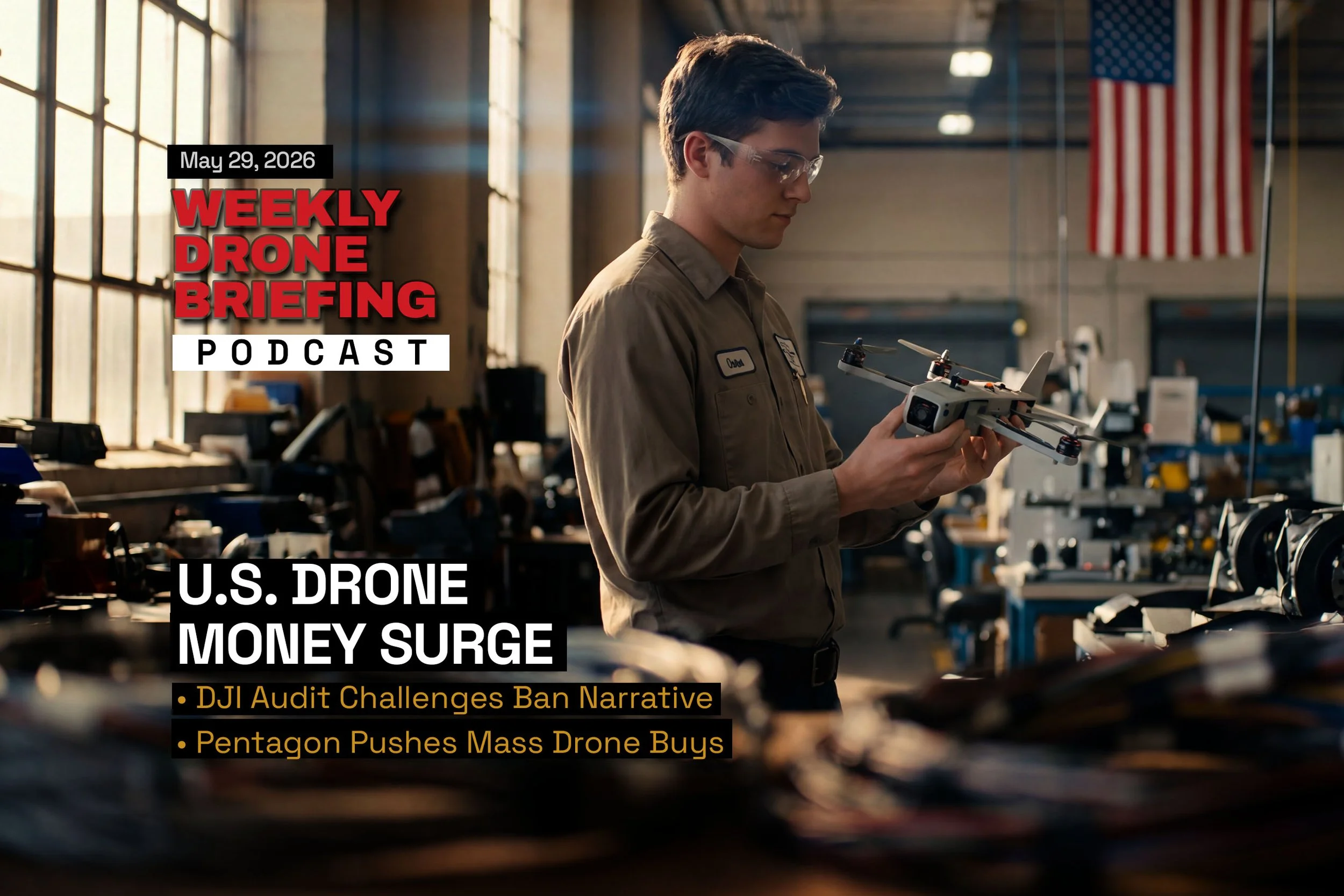
In this episode, we break down:
• The Trump administration's reported plans to fund U.S. drone makers — and why drone stocks jumped double digits
• The Pentagon's 300,000-drone target and the Fort Benning competition
• The FCC's conditional approval pathway — Blueflite, Verity AG, and Air VEV
• DJI's independent security audit and the 3,000+ FCC public comments from American operators
• HoverAir AQUA's global launch — and why Americans can't buy it
• Matternet's $33M raise and reverse merger public-market move
• The Louisiana DA-funded BRINC + Skydio + robot dog program for two parish sheriffs
• The new $256B drone services market projection by 2034
Chapters
00:00 Low-Altitude Airspace Becomes Infrastructure
01:56 Drone Stocks and Pentagon Procurement
05:01 DJI, FCC Pressure, and Data Security
08:53 Consumer Drone Innovation Hits the FCC Wall
10:12 Matternet and Medical Drone Delivery
13:00 Louisiana DFR and Public Safety Funding
16:33 The Drone Services Labor Bottleneck
20:20 What This Week Means for the Industry
21:03 Who Owns the Low-Altitude Sky
Links & Resources
Red Raven UAS On-Site Training: redravenuas.com/services
FAA Part 107 Course: redravenuas.com/part107
Consulting & Program Development: redravenuas.com/consulting
Show Notes & Blog Post: redravenuas.com/blog/2026-05-29-weekly-briefing
For UAS consulting, on-site training, and FAA Part 107 certification, visit redravenuas.com.
-
The Sky Is Becoming Infrastructure
It's the middle of the night. You hear someone breaking into your backyard shed, but before the dispatcher even finishes asking for your cross streets, a drone is already hovering, like 300 feet above your house. Just silently holding position up there. Exactly. And it's beaming high-definition thermal video directly to the responding police officer's dashboard screen. So the officers know exactly where the suspect is hiding before they even, you know, unbuckle their seatbelts. And this isn't a scene from some sci-fi movie. It's happening right now, this week, down in rural Louisiana. And it is completely rewriting the rules of the sky. It is a profound shift, really. I mean, we are watching the very fabric of low-altitude airspace transform from this empty void into a highly complex, heavily trafficked infrastructure grid.
Well, welcome to the Red Raven UAS podcast. Before we jump in, for anyone joining us for the first time, I just want to quickly say who we are. Red Raven UAS provides customized drone training, program development, and expert consulting. At Red Raven, we work with public safety, utilities, and enterprise teams. And our focus is really on one thing, helping you launch and grow a drone program that's safe, compliant, and actually ready for your mission. We do the consulting, the strategy, and the hands-on training that, you know, turns an idea into a real operational tool. Visit redravenuas.com for consulting, training, and FAA Part 107 certification. And check out the current special pricing on our Part 107 course. We are unpacking a massive, truly transformative week in the drone industry.
Whether you are a tech enthusiast tinkering with motors in your garage, an investor managing a portfolio, or just someone walking their dog and looking up at the clouds, the fundamental rules of aviation are changing right over your head. Oh, absolutely. And we aren't just talking about consumer toys or, you know, someone filming their vacation. Far from it. The commercial and defense sectors are moving at this breakneck pace, and the regulatory environment is just desperately trying to catch up. So true.
Drone Stocks, Pentagon Tryouts, and Domestic Manufacturing
Okay, let's unpack this. We have explosive military tryouts. We have a massive regulatory tug of war in Washington over foreign technology. And local police basically bypassing standard budgets to get military-grade tech. Exactly. I want to start with the money and the military. Because, I mean, history shows us that where defense funding goes, the commercial industrial base inevitably follows. I saw some wild movement in drone stocks this week. Rumors started swirling that the Trump administration is looking at direct funding deals for U.S. drone manufacturers. What exactly happened in the markets there? The reaction was explosive. Wall Street didn't even wait for the ink to dry on any official policy. Unusual Machines shot up 57% in a matter of hours. Like 57% in hours. Yeah.
Red Cat went up 33%, AeroVironment jumped 18%, and Kratos saw a 14% surge. That is just massive capital moving instantly. It is. From a strictly market mechanics perspective, investors are reading the tea leaves. They see a federal push to build an agile domestic supply chain, and they are moving massive amounts of capital to front-run that federal money. And that capital movement, it seems directly tied to what the Pentagon is doing on the ground. The briefing notes that the military just ran this intense head-to-head explosive drone competition down at Fort Benning. Right, the live trial. Yeah, and their stated long-term goal is to eventually purchase 300,000 drones. But this is where I'm a little confused. Okay, how so? If the Pentagon knows they need 300,000 units, why run tryouts?
Why set up a muddy obstacle course instead of just awarding one standard, massive, multi-year government contract like they do when they want a new fighter jet? If we connect this to the bigger picture, it represents a fundamental rewiring of how the government procures technology. A traditional multi-year contract for a fighter jet, it takes a decade. Yeah, lots of red tape. You spend years in design, years in simulation, years in testing. But drone technology, specifically software and battery efficiency, iterates on a scale of months. Right, the tech changes too fast for a 10-year plan. Precisely. By running a live tryout, the military is completely bypassing the 10-year development cycle. They are prioritizing immediate agility. They want to see what off-the-shelf, dynamically adaptable domestic tech can do right now in the dirt.
Specifically under electronic warfare jamming conditions, right? Exactly. They need to test electronic warfare resistance. So they want to know which drone can actually acquire a target and deliver a payload when the GPS signal is being actively scrambled. Not what a defense contractor promises it can do in a PowerPoint presentation five years from now. That is the exact mechanism they are testing. And maintaining strict neutrality on the administration's specific policies here, just looking at the procurement strategy, by shifting to this tryout model, the military is sending a clear signal, we will buy what works today. And that immediate demand for functional domestic hardware is what's driving those incredible stock market surges we just talked about. Unquestionably.
DJI, FCC Pressure, and the Data Security Debate
So if the U.S. is heavily incentivizing and pumping money into domestic drone production, you would think American businesses would be thrilled, you know. You would certainly think so. But that federal push is violently colliding with reality on the ground. American commercial drone pilots are hitting a massive regulatory wall regarding foreign-made drones, specifically from DJI. The tension here is immense. The ambition to build a domestic base is actively conflicting with the operational needs of everyday businesses. Let's look at the data security argument. For years, the concern has been that foreign drones might be secretly transmitting sensitive data back to overseas servers. Right. That's the core fear. But DJI just released an independent security audit conducted by an outside firm called OnDefend.
They specifically analyzed the Air 3S consumer drone and the 4E enterprise drone. Can you walk me through how an audit like that actually works? Yeah. An independent cybersecurity audit of this caliber is incredibly rigorous. The auditors don't just look at the physical drone. They perform deep penetration testing on the code itself. Like trying to hack the system from the inside. Exactly. They use packet sniffers to monitor every single byte of data the drone transmits while in flight and when connected to Wi-Fi. Actively looking for any unauthorized phoning home to foreign servers, any backdoor vulnerabilities in the mobile app, and weaknesses in how the drone encrypts video files. And what was the result of all that packet sniffing and code-breaking? Zero critical high or medium risk findings regarding data security.
The audit verified that when the user selects local data mode, which basically severs the drone's internet connection, no data is transmitted externally. Period. That seems like a massive blow to the core argument against them. It definitely complicates the narrative. Meanwhile, the FCC just got flooded with over 3,000 public comments on their proceeding regarding DJI. And these comments aren't from like corporate lobbyists. No, they're from end users. Right. We were talking about utility inspectors, checking power lines, public safety officials looking for missing persons, real estate photographers, everyday professionals. And their message was very clear. Incredibly blunt. They argued that comparable U.S.-made alternatives either simply do not exist yet, or they cost two to four times as much for a system with shorter battery life and inferior cameras.
Are these regulatory bans actually hurting American small businesses more than they help national security? What's fascinating here is how the burden of proof has entirely shifted. For a long time, the regulatory momentum relied on the theoretical potential of data security risks. The what ifs, basically. Exactly. But when you have independent technical audits finding no critical risks, the burden shifts back to the critics. You can no longer rely on broad assumptions. You have to point to specific lines of code or in specific data packets to justify sweeping regulatory actions. Because right now, the regulations are incredibly broad. Let's talk about the FCC's list. How does this regulatory wall actually function? The FCC maintains two distinct frameworks that are crucial to understand. First, there is the Covered List.
This is the broad list of communications equipment explicitly deemed a national security risk. Getting off that list is incredibly difficult. Basically, the blacklist. Right. But then they have a Conditional Approval List. This is a very narrow, highly scrutinized lane for systems that have cleared stringent supply chain reviews. We just saw three companies added to this conditional list. Which one? Blueflite out of Michigan, Verity AG, which is a Swiss company doing autonomous indoor inventory, and Air VEV, an Israeli developer. So to get conditional approval, they have to prove the provenance of every single microchip and wire in their supply chain. Down to the smallest component, it's a grueling audit of manufacturing transparency.
Consumer Drone Innovation Hits a Regulatory Wall
So there is a path through the regulatory wall, but it is bottlenecked and painfully slow. And that bottleneck is crushing companies that have nothing to do with enterprise utility inspections. It's bleeding into the consumer space. Absolutely. Look at the HoverAir. It's this new, highly anticipated waterproof self-flying camera drone. It's meant for people filming themselves kayaking or surfing. It just launched in more than 50 countries around the world. But you cannot buy it in America right now. Right. And it's not because it was deemed a security threat. Why exactly are Americans locked out of buying this? Because the bureaucratic authorization pathways literally shifted beneath them. The FCC recently changed its internal interpretation of the equipment authorization rules for devices utilizing specific radio frequencies. So they just changed the rules mid-game.
Basically, yeah. It created a massive administrative backlog. HoverAir, which was halfway through the old certification process, suddenly found themselves frozen out. It highlights how these broad regulatory frameworks, intended to secure national infrastructure, end up acting like a blunt instrument. One that just crushes consumer innovation and locks everyday buyers out of global tech. Exactly. So if consumer drone companies are bleeding money trying to navigate this unpredictable FCC red tape, where is the smart money actually going?
Matternet and the FAA Type Certificate Moat
Well, it turns out investors are fleeing to the one place that actually thrives on heavy regulation. Which brings us to a company called Matternet. This represents a massive pivot in how Wall Street views the longevity of drone technology. Matternet just announced a $33 million private placement as part of a reverse merger to go public. But the dollar amount isn't the headline here. No, the regulatory status is the headline. Right. Crucially, Matternet is the only drone delivery platform holding an FAA type certificate. And their business model isn't about dropping cold French fries in your backyards as some company posted in a viral video. No burrito deliveries here. They rely entirely on heavily regulated medical logistics. We're talking about flying blood samples between hospitals, delivering lifesaving prescriptions, moving time-sensitive biological cargo.
Here's where it gets really interesting for me. I look at Matternet and it feels like they are building freight trains instead of sports cars. That is an excellent analogy. That's a helpful starting point. But to really grasp what they've accomplished, let's look at the underlying mechanics. Getting an FAA type certificate for a drone is like taking a golf cart and proving to the federal government that it is fail-safe enough to drive in the fast lane of the autobahn. A type certificate is the exact same rigorous airworthiness approval used for crewed aviation. Think about a Boeing 737. So they aren't just filing a waiver that says, you know, we promise to be careful. Not even close.
Under Part 21 certification, they have to prove the mean time between failures for every single motor. They have to prove software assurance levels. What happens if the GPS fails? Exactly. What happens if a battery cell overheats? What happens if a bird strikes a rotor? They had to rigorously test and prove multiple overlapping redundancies until the FAA agreed their uncrewed aircraft is fundamentally as reliable as a commercial jet carrying passengers. That sounds exhaustingly expensive and slow. It is both of those things. But that is exactly why they just secured $33 million. Because they are the only ones holding that certificate for a delivery platform, they have built a massive virtually impenetrable moat around their business. Because nobody else wants to go through that grueling process. Right.
Medical logistics are highly regulated, predictable, and incredibly sticky. Once a hospital integrates an automated drone route into their pathology lab workflow, they don't switch back to ground couriers. Investors are realizing that the highly regulated, type-certified medical route is infinitely more bankable than the consumer pizza delivery model. It's the difference between a luxury gimmick and foundational infrastructure. And speaking of foundational infrastructure, we are seeing these advanced certified drone operations leave the corporate medical space and fundamentally reshape local communities.
Louisiana DFR and Public Safety Funding
Let's move from sky-high hospital deliveries to emergency response on the ground in rural America. This is where we see the technology fundamentally altering how municipalities assess risk and deploy resources. According to the Red Raven UAS briefing, a district attorney down in Louisiana is funding a three-year public safety program for two local parish sheriff's offices. They're using BRINC drones, Skydio aircraft, and even a quadruped robot dog. But the centerpiece of this is a dedicated DFR system housed in a specialized hangar near Plaquemine. For the listener who hasn't encountered this yet, can you break down the mechanics of what DFR actually means? Absolutely. DFR stands for drone as first responder. To understand the shift, think about the old model.
An officer drives to a scene, parks, takes a drone out of their trunk, connects the controller, and flies it. Which takes a lot of time. A ton of time. In a DFR system, the drone is permanently stationed on a roof or in a dedicated weatherproof hangar strategically placed in the city. The hangar is integrated directly with the city's computer-aided dispatch or CAD system. So the moment the 911 dispatcher types in the address. The hangar roof slides open automatically, the drone launches autonomously, and flies in a direct straight line over traffic, over buildings, to the GPS coordinates of the 911 call. Beating the cops there. It arrives minutes before the patrol car.
Using high-definition optical and thermal cameras, it streams a live overhead view back to the dispatch center and to the screens inside the responding officer's cruisers. So they're essentially racing the patrol car to the scene? It's more fundamental than a race. It entirely changes the risk assessment before an officer ever shifts their cruiser into park. They know exactly how many suspects are on scene, if someone is armed, or if a suspect has fled over a fence. Major cities with massive tax bases, like Chula Vista in California, pioneered this with incredible success. Okay, but I have to push back here.
I fully understand how a major metropolitan area with a multi-million dollar police budget can afford CAD integration, automated hangars, and the specialized FAA waivers required to fly beyond visual line of sight. Sure. But how on earth can a tiny rural parish in Louisiana afford this? The hangars, the waivers, the tech that usually only big cities have. This tech is notoriously expensive. That is precisely the breakthrough highlighted in the briefing. The visual of the robot dog is what catches the eye, but the real innovation is the funding mechanism. Historically, a small rural agency couldn't dream of pulling these costs out of their standard operating budget. But in this case, it's the district attorney's office footing the bill for the sheriff's departments. So they completely bypass their own standard municipal operating budgets?
Yes. And it proves that DFR doesn't have to be limited to major cities. Small agencies are getting incredibly creative. They are leveraging funding from parent counties, from local port authorities, or utilizing federal Byrne JAG funds. Wait, what are Byrne JAG funds? It stands for the Edward Byrne Memorial Justice Assistance Grant Program. It is the leading source of federal justice funding to state and local jurisdictions. How interesting. By tapping into these federal grants or pooling resources with the district attorney, small towns are democratizing top-tier life-saving technology. The exact same overhead situational awareness that protects officers in a sprawling metropolis is now protecting deputies on a dark rural highway in Louisiana. That is incredibly clever.
The Drone Services Labor Bottleneck
So we've talked about the massive military investment demanding agile hardware. We've looked at the unpredictable FCC regulations freezing out consumer tech. We've seen Wall Street backing heavily regulated medical delivery. And we've explored how rural police are creatively funding advanced DFR systems. But looking at all of this hardware and investment, there was a final piece of the puzzle. And honestly, it might be the single biggest bottleneck threatening the entire industry. The human element. Exactly. Hardware and software are advancing exponentially, but the workforce required to legally operate and manage it is lagging severely. The Red Raven briefing points to a new market report that is frankly staggering. It projects the global drone services industry will grow from $32.7 billion today to $256 billion by 2034.
That is a 25% compound annual growth rate over the next decade. And the drivers of this growth aren't just defense contracts. It's agricultural operators replacing crop dusters with swarms of autonomous spray drones. It's construction firms doing daily automated site surveys. It's utility companies bringing thousands of miles of power line inspections in-house. Huge commercial applications. So what does this all mean? Are these market projections just Wall Street hype? Or are we genuinely looking at a labor crisis in aviation? This raises an important question about the reality of scaling technology. You always have to take long-term dollar projections with a grain of salt. But the 25% compound annual growth rate is firmly validated by the concrete examples we've discussed today. Hospitals and police departments. Right.
Hospitals are actively integrating Matternet deliveries into their daily budgets right now. Utility companies are actively grounding their expensive helicopter fleets and buying drones. These aren't experimental pilot programs anymore. They are commercial realities. And if an industry grows by 25% every single year, the demand for qualified humans to run those programs compounds right alongside it. That is the core issue. The bottleneck isn't acquiring the hardware anymore. Anyone with capital can buy a fleet of advanced enterprise drones. The bottleneck is the severe lack of FAA-certified Part 107 pilots, aviation program managers and geospatial data analysts. Companies are buying the tech and then realizing they don't have the internal talent to legally put it in the sky, let alone process the terabytes of data it collects.
Did you clarify what Part 107 actually requires? Because I think a lot of people assume it's just, you know, a quick online quiz about not flying near airports. Oh, it's far more rigorous than that. Part 107 is the FAA's official commercial drone pilot license. To pass, you have to learn how to read complex aviation sectional charts. Yeah, you have to understand micrometeorology and METAR weather reports. You need to know the radio communication protocols for navigating Class B airspace around major airports, understand aircraft loading limits, and know the emergency procedures for loss of control links. It's essentially the ground school of traditional aviation, just compressed for uncrewed systems. Yes. And because of that rigor, the labor supply has simply not caught up with the commercial demand.
Which means this $256 billion industry is desperately searching for certified talent. The briefing notes from Red Raven UAS point out that they are actively trying to solve this labor gap. They are. They offer an online Part 107 course specifically designed to get new pilots FAA-certified, navigating all those complex sectional charts and weather reports, and they even back it with a pass guarantee. If you're listening to this and wondering how to interact with this massive shift, understanding that certification process is the foundational requirement to get in the door. It is the literal operating license required to turn this technological explosion into a viable career. Without certified operators, the hardware stays grounded.
What This Week Means for the Industry
Let's pull all of this together. We are watching tectonic shifts across the entire spectrum of aviation. Federal military dollars are moving the markets demanding agile off-the-shelf domestic manufacturing rather than decade-long development cycles. We're seeing the real world friction of the FCC's regulatory wall, forcing small businesses to scramble even as independent audits prove the security of foreign hardware. Right. Serious Wall Street capital is intentionally seeking out the grueling FAA type certificate process, backing heavily regulated medical delivery over consumer stunts. And local rural police departments are securing state-of-the-art DFR technology by creatively tapping into federal grants and district attorney budgets.
Who Owns the Low-Altitude Sky
The industry is maturing rapidly. The regulatory environment is messy and unpredictable. But that friction is exactly what forces an industry to solidify its infrastructure. Absolutely. But as we look at how all these puzzle pieces fit together, the medical deliveries, the autonomous police drones, the agricultural swarms, it forces us to confront a reality that most people haven't even considered yet. Right. Because right now, the sky above our heads, just a few hundred feet up, is mostly empty. But not for long. We've talked about the complex challenge of managing the traffic when all these automated drones share the same low-altitude airspace over our towns. But that leads to an even more fundamental provocative question. It's not just about who controls the traffic. It's about who actually owns that invisible real estate.
What do you mean? Like property rights in the sky? Exactly. Think about it. If a Matternet medical drone flies a fixed route 50 feet directly over your backyard every single hour of the day, or a police DFR drone hovers over your property line to look at a neighbor's yard who actually owns that airspace? For a century, aviation law has focused on high-altitude transit. But as drones leave the military base and the commercial runway to enter our immediate neighborhoods, the next massive legal and cultural battle won't just be about battery life or radio frequencies. It will be about trespassing in the invisible sky right above our lawns.
We are literally laying down the tracks for a brand new sort of infrastructure, and we haven't even decided who owns the land it's built on.
Closing and Red Raven CTA
It's going to be a fascinating battle. It is an absolutely fascinating time to look up. Well, we want to thank you so much for joining us today. We know your time is valuable, and we appreciate you spending it with us. Make sure you follow us so you don't miss a new episode every week, and we will catch you on the next one. Visit redravenuas.com for consulting, training, and FAA Part 107 certification, and check out the current special pricing on our Part 107 course.
About Red Raven UAS
Red Raven UAS helps public safety agencies, government teams, utility operators, energy companies, and infrastructure organizations build drone programs that actually work in the field.
We focus on the parts of a UAS program that matter after the aircraft comes out of the box: pilot training, FAA compliance, SOP development, mission workflows, data handoff, risk management, and long-term program strategy. No hardware sales. No manufacturer hype. No one-size-fits-all curriculum.
Our team brings together decades of real-world operational experience in public safety aviation, commercial drone operations, training, and UAS program development. From initial program planning through on-site instruction, program assessment, and workflow design, Red Raven gives teams the structure they need to deploy drones safely, legally, and effectively.
Explore More