I Failed the FAA Part 107 Exam — Here's What I Wish I'd Known
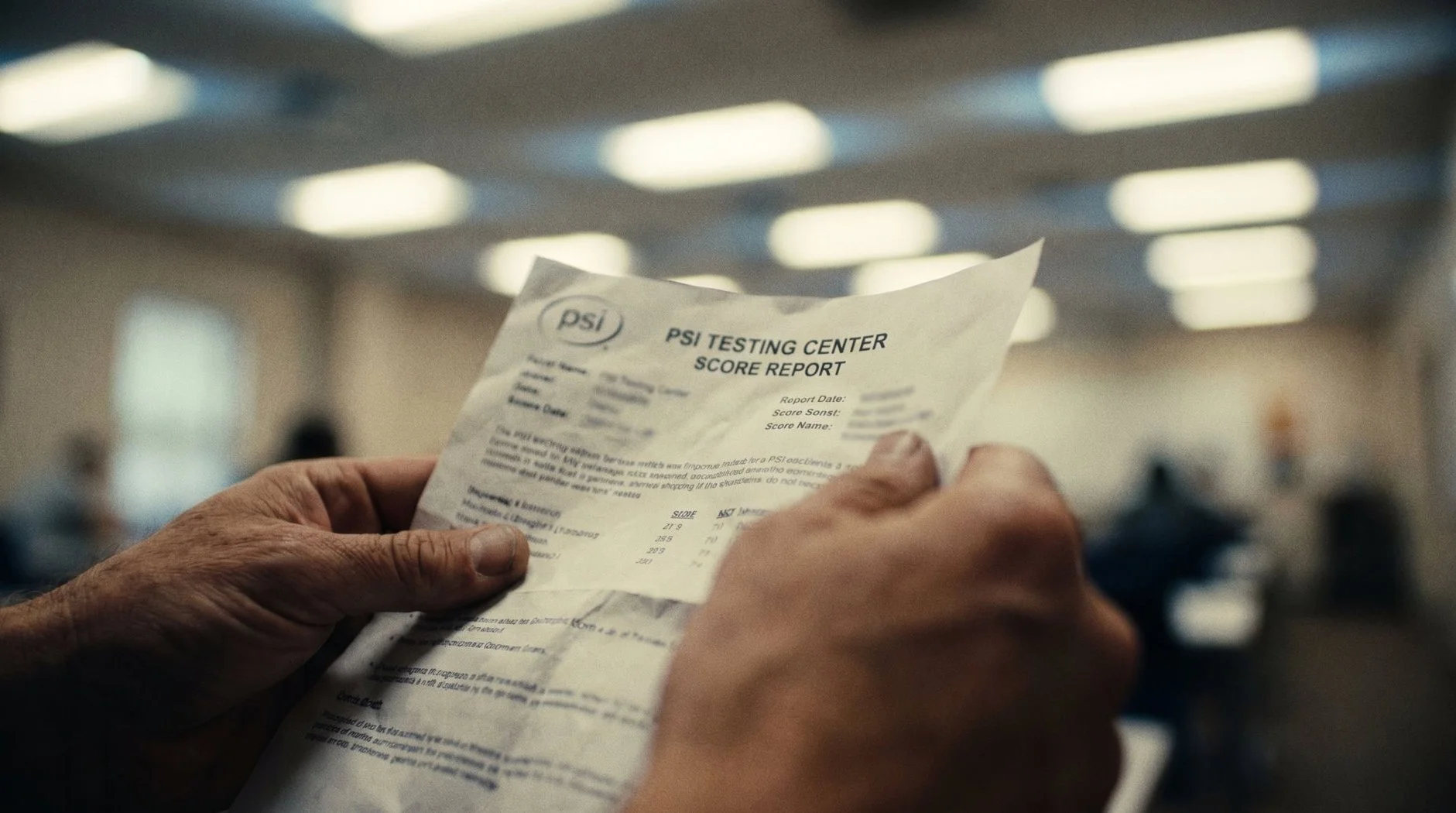
You sat in a quiet room for two hours in the PSI Testing Center. You answered 60 questions. Then the screen showed your result.
FAIL.
Now you are doing the math in your head: how long until you can test again, and how much will it cost you? The answer is at least 14 days of waiting and another $175 out of your pocket.
Here is the thing most people never find out: the majority of people who fail the FAA Part 107 exam were not unprepared. They were prepared the wrong way. And that difference — between studying the wrong material and studying the right material — ends up costing hundreds of dollars and weeks of lost time.
The FAA Part 107 exam, officially called the Unmanned Aircraft General — Small knowledge test, is the written examination every commercial drone pilot in the United States must pass before flying a drone for pay, for work, or for any business purpose. It covers aviation topics — airspace rules, weather interpretation, flight regulations — that have almost nothing to do with actually flying a drone. That is what catches most people off guard.
This guide is for two groups: people who already failed and want to know what went wrong, and people who are still studying and want to make sure they do not end up in the first group. Either way, you are in the right place.
Prefer audio? Listen to the full podcast below or open the episode page.
Why Most People Who Fail Part 107 Were Not Ready — Even If They Thought They Were
The official FAA pass rate for the Part 107 exam is around 92 percent. Most people see that number and assume the test must be easy. It is not — at least not if you are preparing the wrong way.
That 92 percent includes everyone who took a structured prep course, completed real practice exams, and showed up with a solid understanding of what the test actually covers. It includes pilots who spent 15 focused hours building the right knowledge, not 40 scattered hours watching random YouTube videos. Remove those well-prepared students from the data, and the pass rate for people who prepared on their own with free materials looks very different.
People who fail Part 107 are not failing because the exam is impossible. They are failing because they did not know what "actually prepared" looks like.
The Part 107 test has 60 multiple-choice questions. You need to get at least 42 of them right — that is a 70 percent passing score. Here is what the exam actually tests:
Sectional chart interpretation. Sectional charts are paper aviation maps used by manned aircraft pilots. They look like someone poured a bowl of multicolored spaghetti over a topographic map. The Part 107 exam will ask you to read them, identify airspace boundaries, determine altitude limits, and locate airports. If you have never looked at a sectional chart before, this section alone can fail you.
Weather and METAR decoding. A METAR — short for Meteorological Aerodrome Report, which is a standardized aviation weather report issued every hour from airports across the country — looks like pure gibberish on first glance: "METAR KLAX 141853Z 27010KT 10SM FEW025 BKN060 20/14." The exam will ask you to decode these and make flight safety decisions based on what they say.
FAA regulations. Airspace classes, flight restrictions, waivers, night operations, emergency procedures — the rules you are legally required to know as a commercial operator.
Aircraft performance and loading. How weather conditions, altitude, and aircraft weight affect whether a drone can fly safely in a given environment.
None of this is impossible to learn. But none of it is intuitive if you have never studied aviation before. And most free study resources — YouTube channels, free apps, forums — do not cover it completely or consistently.

The 5 Mistakes That Cause Most Part 107 Failures
After watching how people approach Part 107 prep, the same mistakes appear over and over. Here are the five that account for the majority of failures:
Mistake 1: Relying Entirely on Free YouTube Content
Free YouTube videos are not useless. Some of them are genuinely good. But they are random, often outdated, and they have no way of telling you whether you have covered everything the exam actually tests. You can watch 20 hours of YouTube and still walk into the exam missing half the airspace rules because that particular channel never got around to covering them.
A structured course follows a curriculum. Every exam topic is covered in sequence. You know when you are done because the course has an end. YouTube does not have a finish line.
Mistake 2: Skipping Sectional Chart Practice
This is the single biggest source of exam failures. Sectional charts are non-intuitive. They require practice — not just reading about them once, but actually looking at chart after chart until the symbols, colors, and notations become familiar. Most free resources spend one short video on sectional charts and move on. That is nowhere near enough.
Mistake 3: Never Taking a Full Practice Exam
The Part 107 exam has a specific question style. They are not trick questions, but they require you to think through multiple variables before choosing an answer — the way aviation professionals think. If the first time you encounter this style is in the testing room, you are starting the exam at a disadvantage. Practice tests eliminate that disadvantage entirely.
Mistake 4: Using Outdated Study Materials
The FAA has updated Part 107 rules multiple times. Rules around nighttime drone operations changed. Remote ID — a federally required system that makes most drones broadcast their identity and location during flight, similar to a digital license plate — was added to the exam. If your study materials have not been updated for 2025 or 2026, you will see questions on the real exam that your prep never addressed.
Mistake 5: Scheduling Before You Are Consistently Ready
The passing score is 70 percent. But test-day nerves reliably cost people five to ten percentage points. If you are hitting 73 percent on practice tests and you schedule your exam, you are going to walk in and score a 63 percent. You should be consistently scoring 85 percent or higher — not once on a good day, but across multiple full practice exams — before you book your appointment at the PSI testing center. PSI, which stands for Professional Services Industries, is the national testing organization contracted by the FAA to administer the Part 107 exam at authorized locations across the country.
What Sectional Charts Actually Are — And Why Nobody Warns You
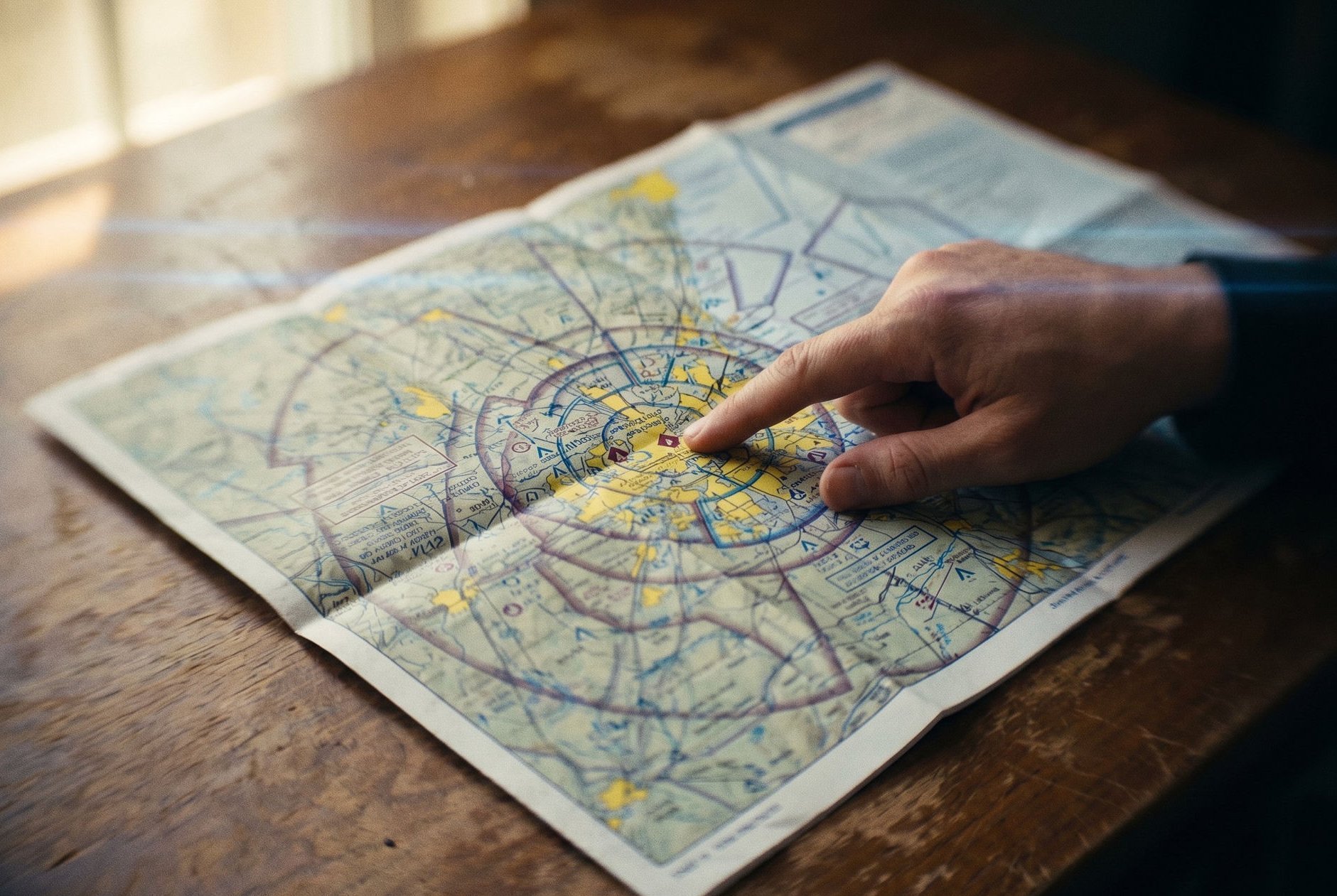
Sectional charts deserve more than a passing mention, because this is where most failures actually originate.
A sectional chart is a standard navigation map used by manned aircraft pilots — the people who fly actual planes. The FAA uses these charts to define airspace for the entire country: which areas are controlled, which require special permission to enter, where airports are, how high aircraft can fly, and what restrictions exist in any given location.
As a drone pilot, you are operating in that same airspace. So the FAA expects you to be able to read these maps.
The problem is that sectional charts look nothing like any map you have ever used. Google Maps, road maps, topographic maps — none of them prepared you for what a sectional chart looks like. Every color means something specific. Every line style means something specific. The magenta circles around airports, the blue dashed lines, the shaded altitude areas, the small numbers scattered throughout the map — each one represents a different kind of airspace boundary, altitude limit, or restriction that affects where and how high you can fly.
You do not learn to read sectional charts by reading about them. You learn by reading them — over and over, on real charts, with real practice questions.

Good prep courses spend significant time on sectional charts with real examples, practice questions, and walkthroughs. The goal is not to memorize every symbol on the chart. The goal is to become fluent enough that when a sectional chart question appears on the exam, you know how to find and confirm the answer quickly. Our Part 107 course covers this from the ground up — including the specific types of chart questions that appear most frequently on the actual exam.
The "Free Is Good Enough" Trap — And What It Actually Costs You
Here is the math most people skip before they start studying.
Free study resources — YouTube channels, free practice apps, forums — cost you time. They might require 40 hours of scattered, unorganized preparation. Some of it will be useful. Some will be outdated. Some will cover topics the exam does not test while missing topics it does. And at the end of all of it, there is no way to know with confidence whether you are actually ready.
Then you pay $175 to PSI to take the exam.
If you fail, you wait the mandatory 14 days. During those two weeks, you are studying more — hopefully with better materials this time — or you are doing nothing and hoping the next attempt somehow goes differently. Then you pay another $175.
At this point, you have spent $350 on exam fees alone, plus weeks of your time, plus whatever you eventually spend on a structured course to get through the retake.
A quality Part 107 prep course is an investment in passing the first time. The Red Raven Part 107 Course is $129 and includes unlimited practice exams and a Pass Guarantee. Complete the course, meet the guarantee requirements, and if you do not pass your first FAA exam attempt, we will refund the amount paid for the course portion of your order. FAA exam and retest fees are not reimbursed.
Not sure where you actually stand? Take our free 12-question Part 107 practice test — it covers the exact topics that trip people up most on exam day. Takes about 10 minutes.

If You Already Failed — Do This Before You Reschedule
If you failed the Part 107 exam and you are reading this, resist the urge to just reschedule and try again with the same approach. That is the most common post-failure mistake — and it usually produces a second failure.
Before you reschedule, do two things.
Step 1: Read Your Score Report
When you fail the Part 107 exam at a PSI testing center, you receive a score report before you leave. This report does not tell you which specific questions you got wrong, but it breaks down your performance by subject area. Look at that report carefully. Any area where you scored below 70 percent is a clear weakness. Any area where you missed more than two questions deserves focused attention. This is your study roadmap for the retake.
Step 2: Change Your Preparation Method
If you studied with free YouTube videos and failed, the answer is not more YouTube. The answer is a structured curriculum that covers every tested topic in a logical sequence and gives you practice questions that match the format and difficulty of the real exam.
The goal for your retake preparation is different from your original preparation. This time, you know what the testing room feels like. You know the question style. You know specifically where you struggled. Use that information.
Aim to score consistently above 85 percent on full practice exams before you reschedule your appointment. Not one good run — consistent results across multiple attempts. That 15-point buffer protects you from test-day nerves and the occasional question phrased in an unusual way.
For a deeper look at the study habits that separate people who pass from people who fail, read our guide to passing the FAA Part 107 exam in 2026.
What Changes When You Use a Structured Course
The difference between passing and failing Part 107 is almost never intelligence. It is almost always preparation method. And a structured course changes the preparation method in three specific ways.
It covers everything. A good Part 107 course follows the actual exam outline. Every topic on the test is covered in the curriculum — not based on what a YouTube creator felt like making a video about, but based on what the FAA actually tests. You finish the course knowing you have seen everything.
It tells you when you are ready. Practice exams that mirror the real test let you measure your actual readiness. When you are consistently scoring 85 percent or above, you have your signal to schedule. Without that, you are guessing.
It reduces the risk. The Red Raven Part 107 Course includes a Pass Guarantee. If you meet the Pass Guarantee requirements and do not pass your first attempt, we refund the amount paid for the course portion of your order. FAA testing fees and the Pilot Toolkit are excluded.
The course also includes a step-by-step PSI scheduling walkthrough, a full guide to the IACRA application — which stands for Integrated Airman Certification and Rating Application, the FAA's online system for processing your certificate after you pass — and an AI study assistant available around the clock for any questions that come up while you study.
-
What is the FAA Part 107 exam, and who needs to take it?
The FAA Part 107 exam — officially called the Unmanned Aircraft General — Small knowledge test — is a 60-question written test required for anyone who wants to fly a drone commercially in the United States. "Commercially" means for pay, for work, or in any way that benefits a business. It tests aviation topics like airspace rules, weather reading, and FAA regulations, and you need a score of at least 70 percent to pass. You take it at an authorized PSI testing center and pay $175 per attempt.
How much does it cost to retake the Part 107 exam after failing?
The retake fee is $175 — the same as the original exam. You also have to wait at least 14 calendar days before you can test again. That waiting period, combined with the second exam fee, is why failing once costs significantly more than just the $175 — you are also losing two to four weeks of potential earning time as a certified pilot.
What are the most common reasons people fail the Part 107 exam?
The most common causes are over-reliance on free YouTube content (which tends to be scattered, outdated, and incomplete), inadequate practice with sectional chart interpretation, and not taking enough full practice exams before scheduling. People who fail are rarely unprepared in general — they are prepared using the wrong method or the wrong materials.
What is a sectional chart, and why does it matter for Part 107?
A sectional chart is a standard aviation navigation map used by manned aircraft pilots. It shows airspace boundaries, airport locations, altitude limits, and flight restrictions across a geographic area. The Part 107 exam requires you to read and interpret them — identifying airspace classes, determining where permission is required, and reading altitude notations. Sectional chart questions are the most frequent source of exam failures among unprepared test-takers.
How long should I study before retaking Part 107 after a failure?
Do not schedule by time — schedule by score. Before you rebook, you should be consistently hitting 85 percent or higher on full practice exams that mirror the real test. Test-day nerves reliably cost five to ten percentage points, so that buffer is important. How long that takes depends on your weak areas, but most students using a structured course reach that benchmark within one to two weeks of focused study.
What is the Red Raven Part 107 pass guarantee?
To qualify, you must complete the full course, score 80% or higher on our final practice exam, and take your first FAA exam within 14 days of earning your Certificate of Completion. If you do not pass on your first attempt, we will refund the amount paid for the Part 107 Course portion of your order to the original payment method. FAA exam and retest fees, the Pilot Toolkit, and all other expenses are not included.
Is the Part 107 exam harder to pass in 2026 than in previous years?
The content has been updated to reflect regulatory changes — including questions on Remote ID (the system requiring most drones to broadcast their location and identity during flight) and updated nighttime operation rules. If you are studying from materials created before 2024, you will likely encounter questions on the real exam that your study materials never addressed. Use a course that has been updated for 2026.
Can I pass Part 107 without buying a prep course?
Yes — some people pass using only free resources. Free materials may require more time and can be outdated, scattered, or incomplete. A structured course provides an organized path and realistic practice exams. Given that the FAA exam costs $175 per attempt, the $129 Red Raven Part 107 Course and its qualifying Pass Guarantee can be a straightforward cost-benefit decision. FAA exam and retest fees are not reimbursed.
Links & Resources
Red Raven Part 107 Course: https://www.redravenuas.com/part107
Free 12-Question Part 107 Practice Test: https://www.redravenuas.com/part107-practice-test
How to Pass the FAA Part 107 Exam (Complete Guide): https://www.redravenuas.com/blog/pass-part-107-exam-2026
Part 107 Exam Cost Breakdown:
https://www.redravenuas.com/blog/part-107-exam-cost-breakdownUnderstanding Airspace for Part 107: https://www.redravenuas.com/blog/part-107-airspace
Red Raven UAS: https://www.redravenuas.com
About Red Raven UAS
Red Raven UAS helps drone pilots get certified and get flying with confidence. Our training is built to make complex FAA topics easier to understand through clear instruction, practical examples, and real-world exam prep. Beyond Part 107 training, we also provide on-site drone training, consulting, and UAS program development for organizations across public safety and industry.
Explore More