How Hard Is the FAA Part 107 Test? Here's What to Actually Expect
Take a look at a sectional chart.
Sectional Chart Excerpt of Dallas / Fort Worth Area. (Source: FAA-CT-8080-2H, Figure 25)
At first glance it looks like someone spilled a bowl of spaghetti on a topographical map. Colors, symbols, numbers, lines — none of it makes obvious sense.
Here's what we want you to know: by the time you pass the FAA Part 107 exam, you will know exactly what every single element on that chart means and how to use it as a drone pilot. Not because you memorized it for a test — but because you actually understand it.
That's what good Part 107 preparation looks like. And that's exactly what this post is about.
First: The Most Important Thing to Understand
The Part 107 exam has nothing to do with your ability to fly a drone.
It doesn't matter how good you are with the sticks. It doesn't matter how many hours you've flown or how smooth your footage looks. None of that is on the test.
The FAA Part 107 exam tests your ability to operate safely in shared airspace — the same sky used by commercial jets, helicopters, small planes, medical aircraft, and military operations. When you earn your Remote Pilot Certificate, the FAA is saying they trust you to understand the rules of that shared system and operate within it responsibly. Not sure if you even need one? Read our guide on Part 107 requirements.
None of this is common sense. It's a real body of knowledge. But it's completely learnable — and once you learn it, it actually makes your flying better.

What to Expect on the Exam
The test is 60 multiple choice questions. You need a 70% to pass — 42 correct answers. You have two hours and access to the FAA Airman Knowledge Testing Supplement, a reference book of charts and figures.
Here's what the questions cover and what they actually mean for you as a drone pilot:
Airspace and sectional charts: That chart above? This is where you learn to read it. You'll understand the different classes of airspace, which ones require permission to fly in, how to identify airports and their control zones, and where you can fly freely. In real life this means knowing before every flight whether you need authorization and how to get it. We cover this in depth in our complete airspace guide for Part 107.
Weather: You'll learn to read METARs and TAFs, the coded weather reports used by pilots. More importantly you'll understand how wind, visibility, temperature, and atmospheric conditions affect your aircraft and your ability to fly safely. In real life this means making smarter go or no-go decisions. Listen to our podcast episode on conquering Part 107 airspace — it covers charts and LAANC in plain English.
FAA Regulations: The actual rules of Part 107. Maximum altitude, Remote ID requirements, night operations, who bears responsibility when something goes wrong. In real life these are the rules you'll operate under every single day as a commercial pilot.
Aircraft performance: How weight, heat, and altitude affect how your drone flies. In real life this means understanding why your aircraft behaves differently on a hot summer day at elevation than on a cool morning at sea level.
Flight operations: Decision making, crew communication, emergency procedures. In real life this is how you think through unfamiliar situations and stay safe.
All of it is teachable. All of it is practical. And when it's taught well, you don't just memorize it for the test — you actually retain it because you understand why it matters.
How Hard Is It Really?
About 84% of people who take the Part 107 exam pass it. The ones who fail are almost always people who went in without adequate preparation — not because the test is designed to trick you, but because the material genuinely doesn't click without proper study.
You can't wing this one. But you also don't need to be an aviation expert. Wondering exactly what it costs to get certified? See our full Part 107 cost breakdown. You need a clear, structured path through the right material — and you need someone to connect the rules to real-world flying so they actually stick.
Most people pass with 10 to 20 hours of focused learning over one to two weeks. If you're brand new to aviation concepts, plan for the longer end. If you follow a well-built course, you'll likely be closer to the shorter end.
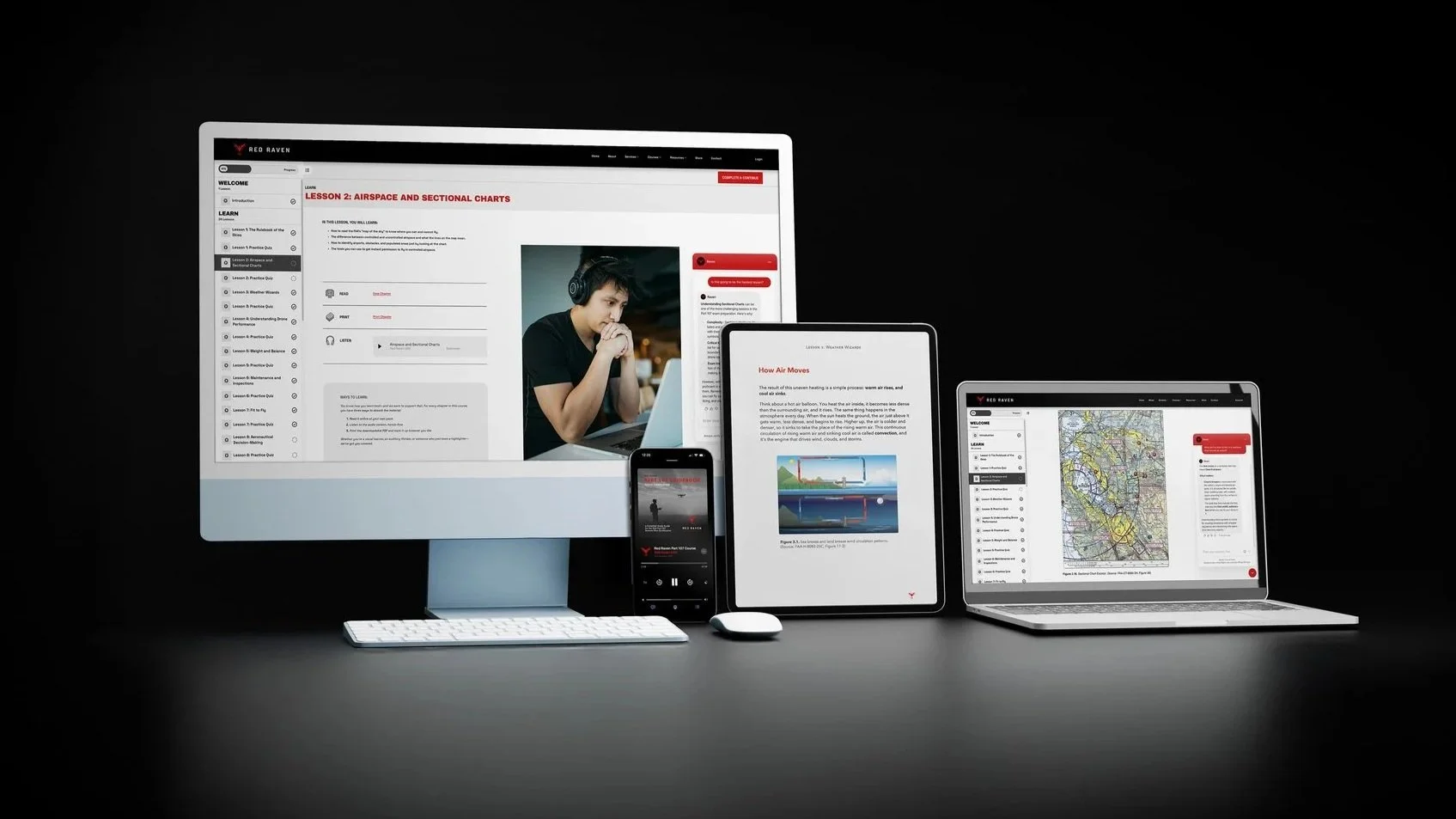
The Red Raven Part 107 Online Course - The Complete Learning System
The Red Raven Difference: A Complete Path, Not Just a Study Guide
Getting your Part 107 certificate isn't just about passing a test. There's a whole process — and if nobody walks you through it, it can feel like a maze.
Red Raven guides you through every single step:
Studying — Our course covers every exam topic in plain English, with real-world context that makes the material stick. We don't just explain the rules — we show you what they mean in practice so you actually remember them long after test day. Ready to see the full study plan? Check out our complete guide to passing the Part 107 exam.
Practicing — Unlimited practice exams built to mirror the real test. You'll know exactly where you stand before you sit down at the testing center.
Scheduling — We walk you through the PSI testing center booking process step by step so nothing surprises you on test day.
FAA paperwork — IACRA account setup, your FAA Tracking Number, linking your test score, your temporary certificate, and your permanent card. Every step, in order, explained clearly so you're never wondering what comes next.
You could figure all of this out on your own. But a guided path that walks you through every step can save far more than its $129 price in time, confusion, and second-guessing.
And if you complete the course, meet the Pass Guarantee requirements, and do not pass your first attempt, we will refund the amount paid for the course portion of your order. FAA exam and retest fees, the Pilot Toolkit, and other expenses are not included.
What Test Day Looks Like

You'll sit in a quiet room at an FAA-approved PSI testing center. 60 multiple choice questions. Two hours on the clock. The Airman Knowledge Testing Supplement is there for you to reference — you don't need to memorize every symbol, you need to know how to find what you need quickly.
Most people finish comfortably within the time limit. Bring your government-issued photo ID, arrive a few minutes early, and trust your preparation.
You Can Do This
The Part 107 exam isn't easy if you walk in unprepared. But with the right study plan, the right guidance, and a couple of weeks of consistent effort — it's very much within reach.
Remember that sectional chart at the top of this page? The one that looked like a complete mess?
By the time you finish the Red Raven Part 107 Course, you'll look at that chart and see a clear, organized picture of the airspace around you — exactly the information you need to fly safely, legally, and confidently as a professional drone pilot.
That's the transformation. That's what getting your Part 107 actually means.
ENROLL NOW — $129
Watch: Red raven Part 107 Course Overview
Links & Resources
FAA Part 107 Online Course & Test Prep: https://www.redravenuas.com/part107
How to Pass the FAA Part 107 Exam (Complete Guide): https://www.redravenuas.com/blog/pass-part-107-exam-2026
Part 107 Requirements: Who Needs It and How to Qualify: https://www.redravenuas.com/blog/part-107-requirements-guide
Part 107 Exam Cost Breakdown: https://www.redravenuas.com/blog/part-107-exam-cost-breakdown
Understanding Airspace for the Part 107 Exam: https://www.redravenuas.com/blog/part-107-airspace
How Hard Is the Part 107 Test FAQ
Is the Part 107 test hard? It's challenging if you go in unprepared — but very manageable with the right study plan. About 84% of people who take it pass. The key is learning the right material in the right way, not just memorizing facts for a test.
Do I need flying experience to pass the Part 107 exam? No. The exam has nothing to do with your ability to fly a drone. It tests your knowledge of shared airspace, FAA regulations, weather interpretation, and safe operations alongside manned aircraft.
What does the Part 107 exam actually cover? Airspace classification and sectional chart reading, weather interpretation including METARs and TAFs, FAA Part 107 regulations, aircraft loading and performance, and flight operations including decision making and emergency procedures.
How long does it take to study for the Part 107 exam? Most people pass with 10 to 20 hours of focused study over one to two weeks. A structured course significantly reduces the time required compared to piecing together free resources.
What score do you need to pass? 70% or higher — 42 correct answers out of 60 questions. You have two hours to complete the exam.
Does Red Raven just help me study or do they help with the whole process? The whole process. Red Raven guides you through studying, practice exams, scheduling your PSI test appointment, and all the FAA and IACRA paperwork required to get your certificate in hand.
What is the Pass Guarantee? To qualify, you must complete the full course, score 80% or higher on our final practice exam, and take your first FAA exam within 14 days of earning your Certificate of Completion. If you do not pass on your first attempt, we will refund the amount paid for the Part 107 Course portion of your order to the original payment method. FAA exam and retest fees, the Pilot Toolkit, and all other expenses are not included.
What should I bring to the Part 107 exam? A valid government-issued photo ID. The testing center provides everything else — the reference supplement, scratch paper, and a basic calculator. Arrive a few minutes early and you're set.
Explore More