UAS Weekly Briefing — May 22, 2026: Ontario's Drone Ban, a $500M Counter-UAS Deal, and Dallas Drone First Responders
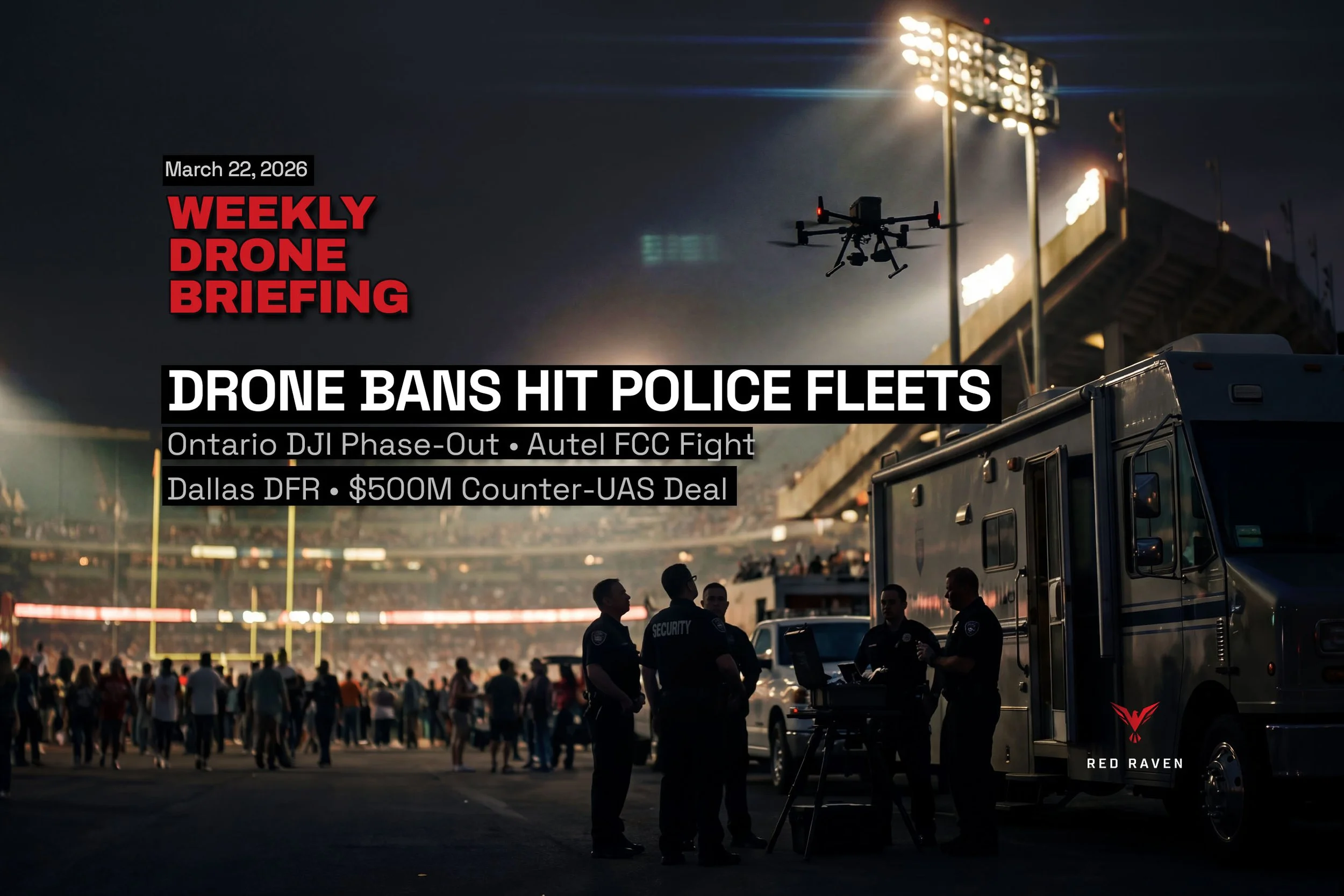
Three years ago, a government banning Chinese-made drones was front-page news. This week, Canada's largest province did exactly that — and it barely registered. That tells you how far this story has traveled.
Meanwhile, the Pentagon committed up to half a billion dollars to drones built to hunt other drones, and one of America's biggest cities switched on a system where a drone — not a patrol car — is first to your 911 call.
This is your Red Raven UAS Weekly Briefing for May 22, 2026. Six stories. Here's what happened, and what it means for you.
The Drone Ban Fight Moves on Two Fronts
The single biggest story in commercial drones over the past year has been the slow squeeze on foreign-made drones — especially those built by DJI, the Chinese company that makes the majority of the drones flown by public safety agencies and businesses across North America. This week that story moved on two fronts at once.
Front one: Ontario bans Chinese-made drones
On May 20, the government of Ontario — Canada's largest province — announced it will bar the Ontario Provincial Police (the OPP, the force that covers most of the province) from using Chinese-made drones on its most sensitive operations. It will also begin phasing Chinese-made drones out of every provincial government agency.
The concern behind the decision is a legal one. Under Chinese law, companies based in China can be compelled to hand data to the Chinese government — even data stored outside the country. Ontario's position is that a police drone flying surveillance over an organized-crime investigation shouldn't carry that risk.
Ontario is not the first to make this argument. Florida banned Chinese-made drones for state agencies in 2023. The Royal Canadian Mounted Police — Canada's national police — restricted its own Chinese-made fleet in December 2025. The U.S. Federal Communications Commission added DJI to a national-security list at the end of 2025. Ontario is simply the latest.
There are two catches. First, Ontario paired the ban with "Buy Ontario," a provincial policy that favors local manufacturers — even though no Canadian company currently builds a true equivalent to the DJI drones police rely on for search-and-rescue, accident reconstruction, and missing-persons cases. Second, DJI pushed back hard. On May 21 the company called the move a country-of-origin decision unsupported by any published security evidence, noting its drones have passed multiple independent security reviews.
Front two: Autel challenges the FCC
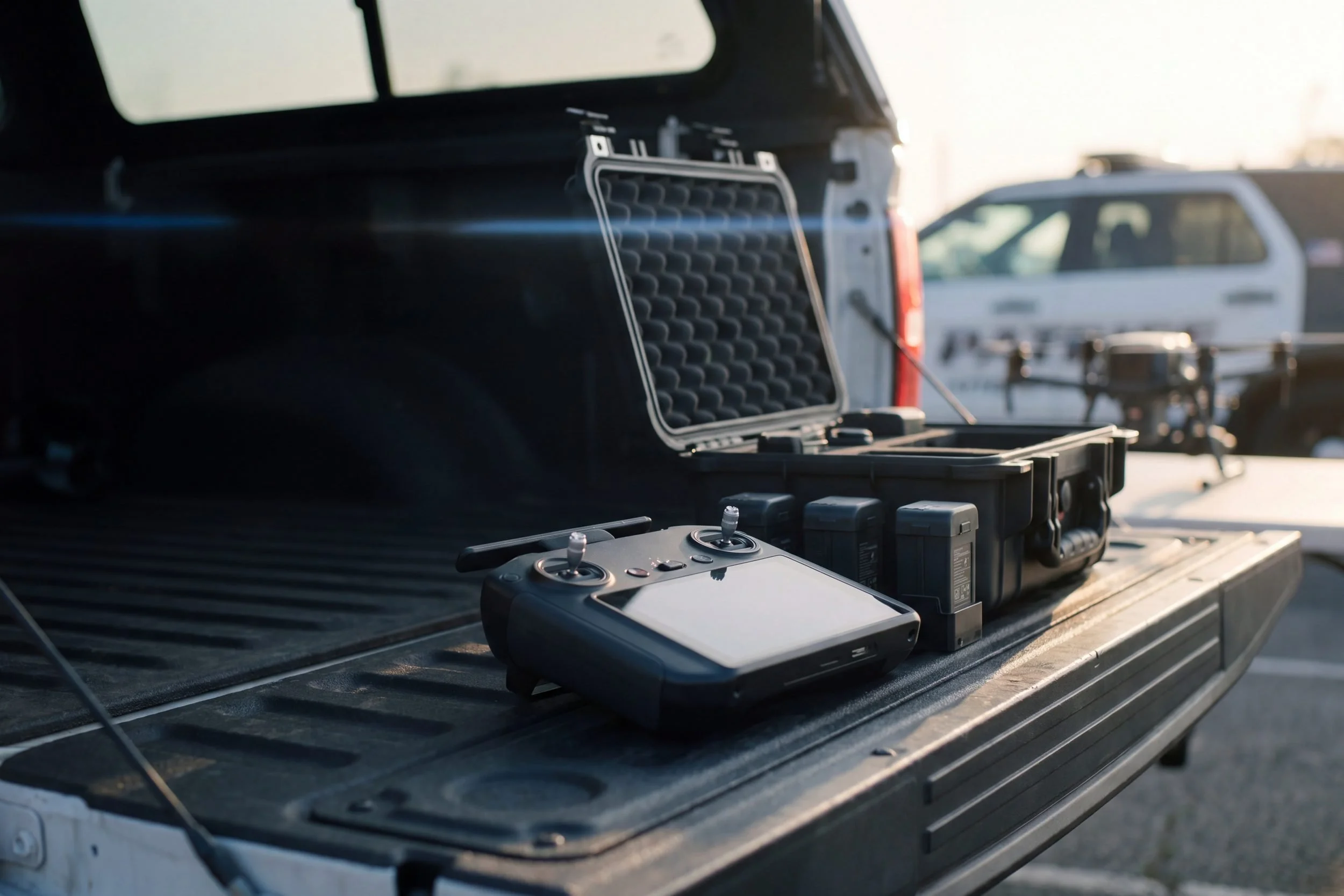
The second front opened in the United States. On May 19, Autel Robotics — another foreign drone maker — filed a sharply worded challenge with the FCC, the federal agency that decides which communications equipment can legally be sold in the U.S.
Here's the background. At the end of 2025, the FCC added DJI and Autel to the Covered List — a roster of communications equipment and services the government considers a national-security risk. Products tied to that list can lose the FCC authorization path they need for future U.S. sales. Existing drones already in the field keep working; the pressure is on new approvals and future procurement.
Autel's argument is pointed: the FCC relied on broad foreign-drone concerns and never did a company-specific review of Autel itself. In plain terms, Autel is trying to separate itself from DJI rather than fight the whole ban. That's the real shift — what used to be one unified industry fight is now splintering, with manufacturers arguing their own cases. You can read our full explainer on the DJI drone ban for the longer backstory.
Red Raven’s Take
If your agency or company flies DJI or Autel hardware, nothing grounds your fleet today — existing drones remain legal to fly on both sides of the border. But every new restriction makes a foreign-made fleet a harder long-term bet, especially if you bought those drones with federal or state grant money that carries its own procurement strings. The concrete move this week: pull together a simple inventory of which of your drones are foreign-made, confirm what your funding source actually requires, and start pricing domestic alternatives before you're forced to replace anything in a hurry.
Read more: Ontario Bans Chinese Drones for Sensitive OPP Work — DroneXL
Read more: Autel Challenges FCC Covered List Decision — DroneLife
Prefer audio? Listen to the full podcast below or open the episode page.
The Pentagon Puts $500 Million Behind Drones That Hunt Drones
This week the U.S. Department of Defense committed serious money to the other side of the drone equation — not flying them, but stopping them.
The Pentagon awarded a contract worth up to $500 million to Perennial Autonomy, a California defense-technology startup founded by former Google CEO Eric Schmidt. The work falls under counter-UAS — short for counter-unmanned-aircraft-systems, the formal term for technology that detects, identifies, and stops hostile or unauthorized drones.
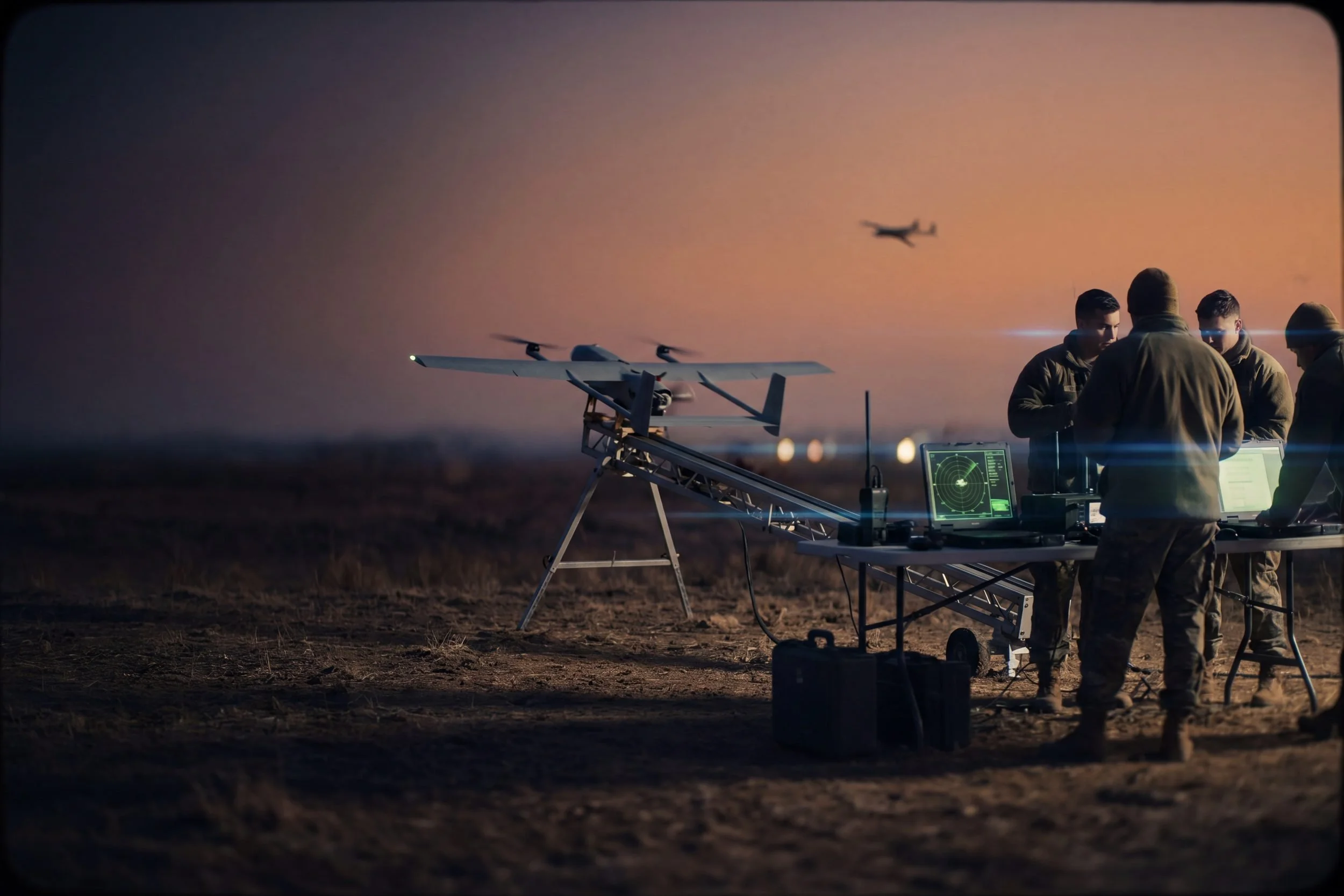
Perennial's specialty is drone-on-drone defense: small, fast interceptor drones that fly directly into an incoming threat and disable it. Its systems — named Merops, Bumblebee, and Hornet — were battle-tested in Ukraine and are already in use by U.S. forces.
One detail is worth pausing on: the money. A "$500 million contract" sounds like a single giant check, but it isn't. It's what's called an IDIQ contract — indefinite delivery, indefinite quantity — with a $500 million ceiling spread over three years. That means $500 million is the maximum the military can order against as needs arise, not a guaranteed lump-sum payment. The contract was awarded by JIATF-401 (Joint Interagency Task Force 401), the Pentagon arm dedicated to counter-drone systems.
Why does a young startup get this kind of backing? Cost math. A single Merops interceptor costs roughly $15,000 — less than half the $30,000-to-$50,000 price of a Shahed, the Iranian-designed attack drone Russia launches at Ukraine by the hundreds. Cheap defense beating cheap offense is the equation every military is now chasing.
And Perennial isn't the only big defense-drone move this week. On May 18, Northrop Grumman — one of the largest U.S. defense contractors — was named one of five preferred payload providers for the Pentagon's separate "Drone Dominance" program, a roughly $1 billion effort to field more than 200,000 drones by 2027. Northrop will supply a standardized, off-the-shelf weapons module to arm large numbers of low-cost drones quickly. Put the two announcements together and the direction is clear: the U.S. is investing heavily in both building drones and defeating them.
Red Raven’s Take
This is primarily a defense story, but it doesn't stay in the defense lane. The counter-drone technology and the "every drone should be electronically visible" mindset being built for the battlefield will shape the airspace rules civilian operators fly under at home — and the federal dollars pouring into U.S. drone manufacturing are speeding up the domestic, non-Chinese alternatives that public safety and enterprise teams will eventually buy. If you're designing a drone program now, treat counter-drone awareness as part of it: know how you'd spot an unauthorized drone over your operation and who you'd call.
Read more: Pentagon Backs AI Counter-Drone Startup With $500 Million Deal — DroneLife
Read more: Northrop Grumman Named Preferred Munitions Provider for Drone Dominance — Northrop Grumman
Dallas Turns On Drones That Beat the Patrol Car to the Call
On May 20, the Dallas Police Department launched a Drone as First Responder program — usually shortened to DFR.
Here's the idea in plain terms. Normally, when you call 911, you wait for an officer in a car. In a DFR program, a drone is dispatched at the same time and arrives first, streaming live video back to officers and dispatchers so they know what they're walking into before anyone gets there.
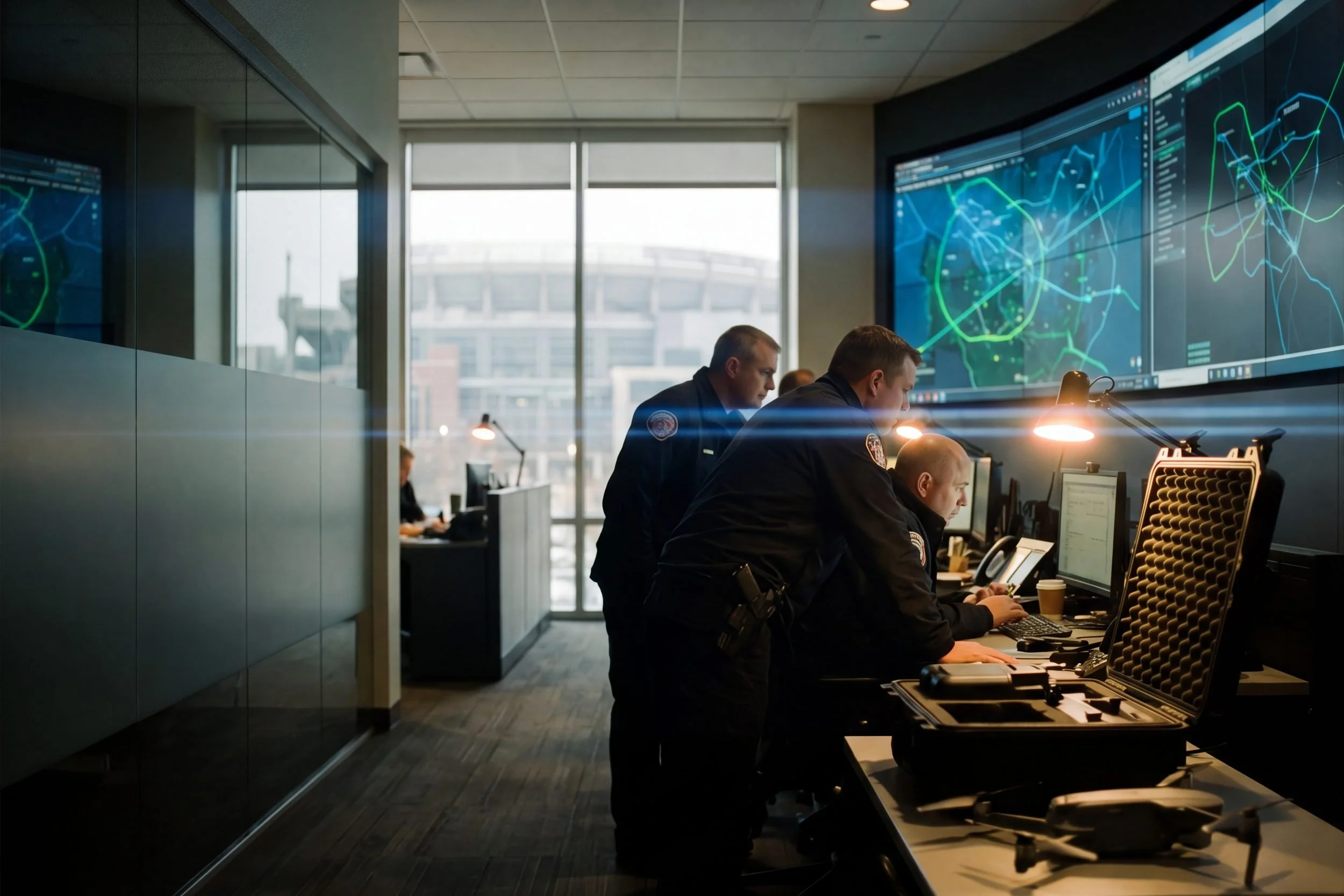
Dallas built its program around eight drones based at fire stations across the city and flown remotely from the department's Real Time Crime Center — a central hub where staff monitor live feeds and coordinate response. A drone can reach a call within roughly a two-mile radius of its base in as little as two minutes. The drones fly up to 200 feet high and up to 35 mph, and each one carries a thermal camera — which sees heat instead of light, making it useful at night — plus a loudspeaker for talking to people on the ground.
For now the program handles specific call types: suspicious people and packages, and reports of random gunfire. The value is in what the drone tells responders. An officer rolling up to an unknown scene is rolling up blind. A drone overhead can confirm whether a call is real, whether a weapon is involved, or whether the situation has already resolved — and in some cases clear the call entirely without sending an officer, freeing that unit for a real emergency.
Dallas is the ninth-largest city in the United States. A department that size putting DFR into live operation is a signal that this model is moving from pilot projects to mainstream policing. We've written before about how Drone as First Responder programs work and what it takes to build a public safety drone program — and the short version is that the aircraft is the easy part.
Red Raven’s Take
For police and fire leaders watching DFR spread from city to city: the technology is no longer the hard part. The hard part is the program — FAA airspace approvals, pilot training, written standard operating procedures, and the data and privacy policies that keep the public on your side. A drone that beats the patrol car to the call only helps if the people behind it are trained and the program is built to withstand scrutiny. If your agency is weighing a DFR program, start with those four pillars, not the hardware catalog.
Read more: Dallas Police Launch Drone Program That Can Respond to 911 Calls in Minutes — CBS Texas
Drone Delivery Keeps Spreading — Now It's Tacos and Texas Suburbs
Two drone-delivery stories landed this week, and together they make one point: getting something delivered by drone is quietly becoming ordinary.
The first is food. Taco Bueno, a Tex-Mex fast-food chain, teamed up with Zipline — one of the largest drone-delivery companies in the world — to deliver meals by air in North Texas. Customers order through the Zipline app, and a drone flies the order over and lowers it gently to the ground on a tether. Service started in Watauga, Texas, and is expanding to the Frisco and Mesquite areas by the end of May, with six to seven more locations planned through 2026.
The second is packages. On May 19, Amazon announced that its Prime Air drone-delivery service will launch in Baton Rouge, Louisiana this summer. It will use Amazon's MK30 delivery drone to carry packages under five pounds to customers within a 7.5-mile radius, with Prime members paying $4.99 per delivery.
For years, drone delivery was a tech demo — a flashy video that never quite became a service you could actually use. That's changing. National brands are now treating drone delivery as infrastructure: a logistics layer they can plug into, the same way they plug into UPS or DoorDash today. This builds directly on last week's launch of a Wing and Papa John's delivery pilot — the pace is picking up.
There's a regulatory thread worth understanding here. These flights depend on FAA permission to fly a drone Beyond Visual Line of Sight — BVLOS — meaning the drone travels far enough that the operator can no longer see it directly. BVLOS approval is the same hurdle that any advanced commercial drone operation, from long-range pipeline inspection to large-scale mapping, has to clear.
Red Raven’s Take
Every delivery launch like these opens a regulatory path — FAA waivers, airspace authorization, and Beyond Visual Line of Sight approval — that the whole commercial drone industry eventually uses. If you're an enterprise or utility team eyeing drones for inspections, mapping, or cargo, the rules being written for burritos and Amazon packages today are the rules you'll operate under tomorrow, so it's worth tracking them. Those operations still depend on trained, certificated aviation teams — and for most commercial drone work, the FAA Remote Pilot Certificate is step one. Our Part 107 course is the fastest way there.
Read more: Taco Bueno Brings Zipline Drone Delivery to Texas — DroneDJ
Read more: Amazon Prime Air Picks Baton Rouge for Summer MK30 Drone Delivery — DroneXL
Kansas City Builds the First World Cup-Era Drone Defense Network
The FIFA World Cup — the biggest soccer tournament on the planet — kicks off June 11, 2026, with matches spread across the United States, Canada, and Mexico. Last week we covered the FAA's "No Drone Zone" campaign, which warns pilots to stay away from stadiums and fan festivals. This week, one host city showed what that defense actually looks like on the ground.
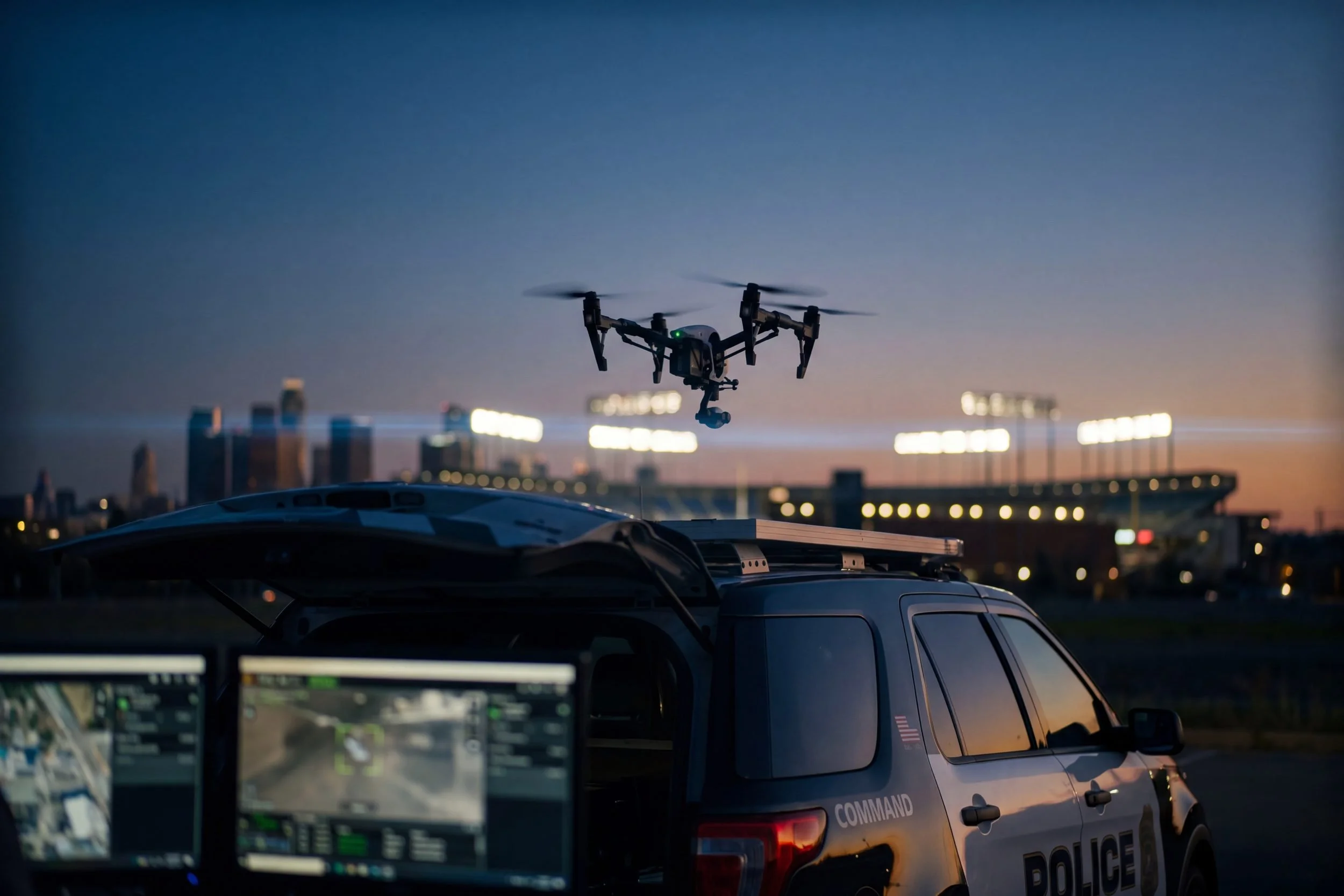
On May 14, the Kansas City Police Department — working with a company called Airspace Link and several regional public-safety agencies — launched an integrated drone-coordination and counter-UAS platform. It's one of the first systems of its kind in a U.S. World Cup host city.
Here's what it does. Most agencies in a metro area already own some kind of drone-detection equipment, but each one runs on its own separate system. Kansas City's platform pulls all of those feeds into a single shared screen, so police don't have to check ten different networks to see what's flying over the region. It adds radar and low-altitude tracking of crewed aircraft, uses Airspace Link's "AirHub" software as the coordination layer, and uses technology from a company called DroneShield to detect and classify possible threats.
The result is one clear picture of who is planning to fly where and when — and which drones are following FAA rules and which aren't. That distinction matters: it lets responders tell the difference between a hobbyist who accidentally wandered into restricted airspace and a drone being flown with harmful intent. Six World Cup matches are scheduled at Kansas City's Arrowhead Stadium.
Two things make this more than a one-off. The platform was supported through federal homeland-security grant funding — so other cities have a funding model to study. And it doesn't get switched off after the tournament: Kansas City plans to keep it running permanently, where it will also support local Drone as First Responder programs.
Red Raven’s Take
If your agency or city has a major event on the calendar — and that's not just the World Cup, but any large public gathering — Kansas City is the playbook: integrate the detection tools you already own into one shared picture, plan months ahead, and understand which federal grant paths can support the work. And whether you fly near a host city this summer or not, check current FAA airspace data, LAANC availability, and active TFRs before every flight from June 11 through July 19. The temporary no-fly zones around venues can bring serious FAA penalties, confiscation, and law-enforcement action.
Read more: Kansas City Builds a World Cup-Era Drone Defense Network — DroneLife
The Bottom Line
Six stories, one throughline: drones are no longer an emerging technology to keep an eye on. They're infrastructure — regulated, funded with serious public money, and operating in real cities right now. For the agencies, utilities, and enterprise teams building drone programs, the question has shifted. It's not whether to fly. It's whether your program is built to last — with trained pilots, solid procedures, and a clear-eyed hardware plan.
That's the work we do at Red Raven. Whether you're an individual chasing your first paid flight through our Part 107 course or an agency standing up a full program, we help you build it right the first time. Reach out anytime — and we'll see you next Friday.
-
Can I still fly my DJI drone in the United States?
Yes. Existing DJI and Autel drones remain legal to fly. The current restrictions are aimed at future approvals, sales, and government procurement — they do not ground drones already in service.What is the FCC Covered List?
It's a U.S. national-security list of communications equipment the government considers a risk. Products on the list cannot get the FCC authorization required to be sold in the United States. DJI and Autel were added at the end of 2025.Why did Ontario ban Chinese-made drones?
Ontario cited Chinese laws that can require Chinese companies to hand over data. It barred the Ontario Provincial Police from using Chinese-made drones on sensitive operations and will phase them out of all provincial agencies. Existing drones are not immediately grounded.What is a Drone as First Responder (DFR) program?
It's a program where a drone is dispatched to a 911 call and arrives before officers, streaming live video so responders know what they're facing. Dallas launched one on May 20 with eight drones that can reach a call in about two minutes.What is counter-UAS or counter-drone technology?
It's technology that detects, identifies, and stops unauthorized or hostile drones. It ranges from radar and radio-frequency sensors to interceptor drones that physically disable a threat.Do I need a license to fly a drone for delivery or any paid work?
Yes. Any drone flight connected to a business or paid work requires an FAA Part 107 Remote Pilot Certificate. Our Part 107 course walks you through the exam and the FAA paperwork.Will there be no-fly zones during the 2026 FIFA World Cup?
Yes. The FAA will issue Temporary Flight Restrictions — short-term no-fly zones — around U.S. match venues and fan festivals from June 11 through July 19. Check current FAA airspace data, LAANC availability, and active TFRs before flying near any host city.Is the Pentagon's $500 million counter-drone contract a guaranteed payment?
No. It's an IDIQ (indefinite delivery, indefinite quantity) contract with a $500 million ceiling over three years — the maximum the military can order against as needs arise, not a lump-sum payment.
Links & Resources
Part 107 Course: https://www.redravenuas.com/part107
Services & Consulting: https://www.redravenuas.com/services
Weekly Briefing Archive: https://www.redravenuas.com/news
Podcast: https://www.redravenuas.com/podcast
DJI Drone Ban Update: https://www.redravenuas.com/blog/fcc-drone-ban-update
How to Build a Public Safety Drone Program: https://www.redravenuas.com/blog/build-public-safety-drone-program-guide
Contact: https://www.redravenuas.com/contact
About Red Raven UAS
Red Raven UAS was founded by public safety and drone industry veterans who understood the gap between having drones and knowing how to deploy them effectively. Our team brings together decades of real-world operational experience — including building one of the nation’s first major public safety drone programs — and deep expertise in the commercial UAS sector across energy, utilities, and infrastructure.
We work with utility operators, energy companies, infrastructure organizations, and public safety agencies to build drone programs designed around their specific assets, workflows, and operational requirements — not a generic course deck. No hardware sales. No one-size-fits-all curriculum. Just field-tested instruction and independent program development guidance from people who have actually built and operated UAS programs at scale.
From initial program assessment and ROI modeling through pilot training, SOP development, and data workflow design, Red Raven delivers the full program infrastructure teams need to deploy drones effectively — and keep them performing. Start with Part 107 or talk to our consulting team.
Explore More