Can You Pass the Part 107 Test? Take This Free Practice Test
Most people who fail the Part 107 exam thought they were ready.
Not unprepared — actually ready. They'd watched the YouTube videos, gone through a study guide or two, maybe knocked out some practice questions from a free quiz site. The concepts felt familiar. They were confident going in.
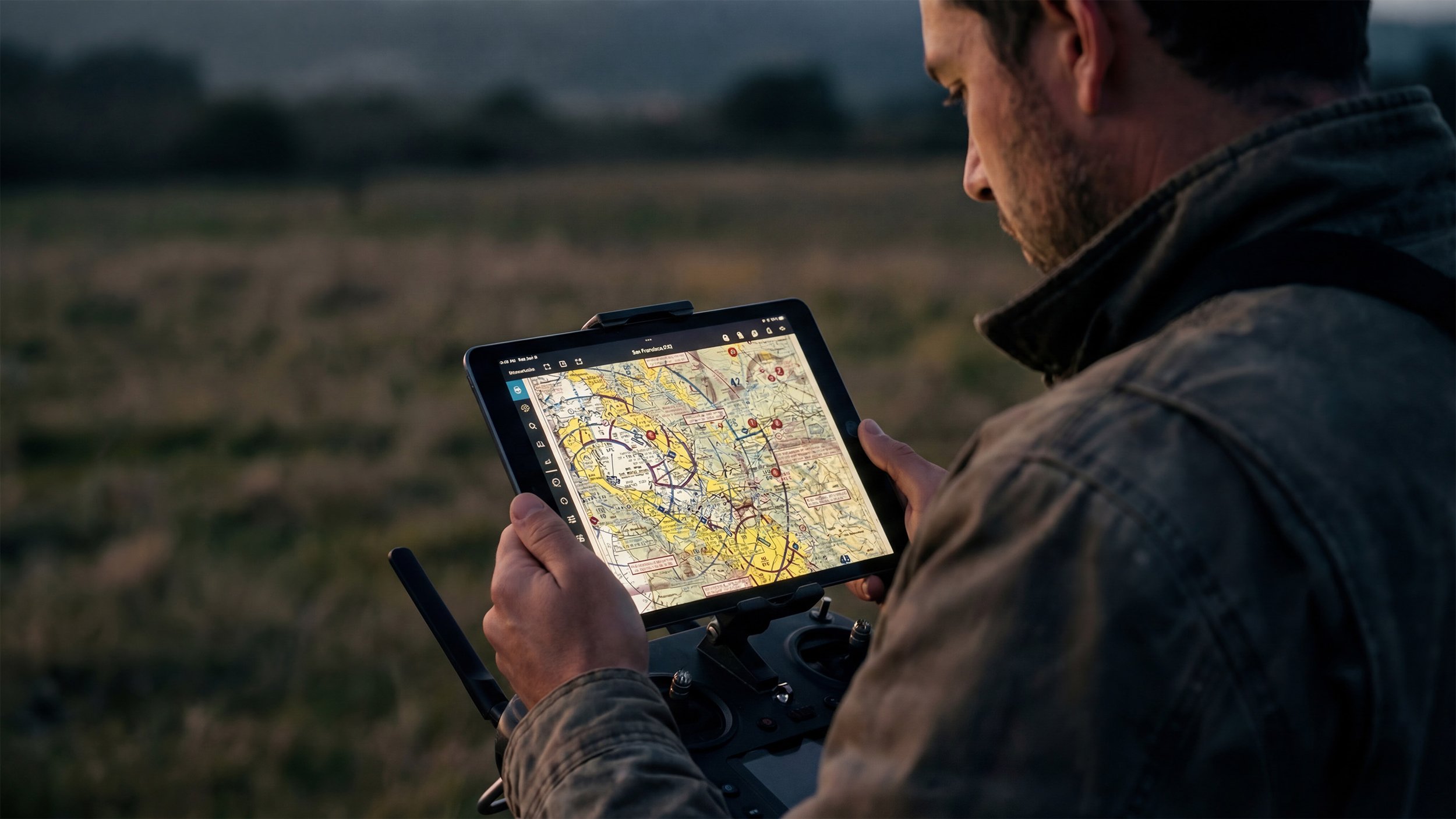
Then they sat down at the testing center and ran face-first into a dense sectional chart — that's one of the aviation navigation maps covered in overlapping symbols, color-coded airspace boundaries, and dozens of abbreviations — and had to identify exactly what type of airspace a specific location fell within. Or they got a METAR, the coded weather report format aviation uses to communicate current conditions at airports, and had to decode wind speed and visibility from a string of letters and numbers in under a minute.
That's the Part 107 exam. The disconnect between how most people prepare and what the test actually requires is exactly why a significant percentage of people walk out needing to retake it.
The fastest way to find out where you actually stand? Test yourself now — before you schedule the exam, before you pay the fees, before you show up at the testing center confident in the wrong things.
→ Take the Free Part 107 Practice Test and see your score instantly.

What the Part 107 Test Actually Covers
The Part 107 exam — Part 107 refers to the section of FAA (Federal Aviation Administration) regulations that governs commercial drone operations, meaning any time you fly a drone for work or to earn money — is 60 questions, multiple choice, administered at FAA-approved testing centers across the country. You need to score at least 70 percent to pass. That means you can miss up to 18 questions. Below that threshold, no certificate — just a retake and another testing fee.
The test covers four main subject areas:
Airspace. The United States has a layered airspace system — different zones with different rules, different altitudes, and different requirements for getting permission to fly. The exam tests whether you can read a sectional chart and correctly identify what type of airspace a given location falls within, and what rules apply there. This includes knowing when you need authorization to fly, how to get it, and what altitude limits apply in each zone.
Weather. This includes reading METAR reports — the standardized format aviation uses to describe current conditions at an airport, covering wind speed and direction, visibility, temperature, cloud cover, and more. Part 107 sets specific weather minimums for legal drone operations, and the exam will ask you to apply them.
Regulations. The specific FAA rules covering what drone pilots can and can't do under Part 107 — altitude limits, operating near airports, night operations, flying over people, incident reporting requirements, and more. These are learnable, but the precise wording matters on exam day.
Operations and Decision-Making. Scenario-based questions that test your judgment. Given a specific situation — weather conditions, airspace class, a conflict with a manned aircraft — what is the safe and legal course of action? These questions test whether you can apply the rules, not just recall them.
The test is not about how well you can physically fly a drone. You could have thousands of hours of flight time and still fail this exam if you haven't studied the specific material the FAA tests. Flying skill and regulatory knowledge are two different things, and the exam only measures one of them.
Why So Many People Think They're Ready — and Aren't
This is the part worth slowing down on.
The most common version of Part 107 failure isn't "I didn't study at all." It's "I studied, but not the right way." And the tricky thing about that kind of failure is that it feels like success right up until the exam starts.
People watch YouTube videos until the terminology starts to sound familiar. They do free practice questions — but many free resources use simplified questions that don't match the actual difficulty or phrasing of the FAA exam. They feel prepared, because nothing they've seen has genuinely challenged them.
Then the real exam shows up with questions written in the precise, specific language the FAA uses in its regulations. Questions where the difference between right and wrong is a single qualifier: "within a 400-foot radius," "without a waiver," "maximum altitude above ground level," "sustained flight over." If you're not used to reading FAA-style questions, you will miss answers you actually know the material for.
There's also the experience trap. Experienced drone pilots often assume their field time gives them an advantage on the exam. It doesn't — not directly. The Part 107 test doesn't ask you to fly. It asks you to demonstrate knowledge of regulations, charts, and weather. Two completely different skill sets.
A lot of people "recognize" the material without being able to reliably answer questions on it. Recognition and active recall are not the same thing, and the exam only cares about one of them.
For a detailed look at how to study the right way, read our complete guide to passing the Part 107 exam. But if you want to know right now where your gaps are, the fastest move is to test yourself with something realistic.

The 3 Areas That Cause the Most Trouble
Not all four exam topics trip people up equally. Three in particular consistently separate the people who pass on their first attempt from the people who don't.
1. Sectional Charts
Sectional charts are the navigation maps aviation uses to display U.S. airspace. They show airports, airspace class boundaries, elevation data, radio frequencies, and dozens of other symbols across a dense, color-coded grid. At first glance, they look overwhelming — and that's the problem.
Once you learn the system, patterns emerge and the charts become readable. But that learning has to actually happen. Too many study guides move through sectional charts quickly and at a high level, leaving students feeling like they vaguely understand them — but unprepared when the exam shows a specific chart excerpt and asks them to make a precise identification.
The FAA regularly uses real sectional chart sections in exam questions. If you haven't spent meaningful time learning to read them, those questions will cost you. Our post on understanding airspace for Part 107 is a good starting point for building that foundation.
2. Weather and METARs
A METAR is a standardized aviation weather report. It looks like this: KLAX 151753Z 27014KT 10SM FEW050 25/11 A2994
If you know how to decode that line, you're ahead of most test-takers. If you don't — that's exactly the type of question the FAA will present. METARs are learnable; the format is structured and consistent once you understand it. But you have to practice with real examples before the exam, or the format will feel like noise under pressure.
Part 107 requires minimum weather visibility of 3 statute miles and minimum cloud clearance distances depending on airspace class. The exam expects you to read a METAR and determine whether conditions meet the legal threshold for flight. That's a specific skill that only comes from practice.
3. FAA Question Phrasing
This is the one most people don't anticipate. Some of the harder exam questions aren't conceptually difficult — they're easy to miss because of how precisely the FAA uses language.
A question that looks straightforward can have a wrong answer that sounds right, and the correct answer buried in a qualifier most people skim past. Words like "unless," "except when," "within a horizontal radius of," "above the highest point of," and "without a waiver" are not decorative — they are the answer. If you're not used to reading questions the way the FAA writes them, you'll miss answers on material you genuinely know.
The sample questions below give you a feel for this phrasing style. And the full practice test will show you where your specific weaknesses are before they show up on the real exam.
Try a Sample Part 107 Question
Here are two questions pulled from the free test. See how you do before scrolling to the full 12-question version.
Question 1 — Regulations (Easy)
Under Part 107, when flying a drone in Class G airspace — the uncontrolled airspace where no air traffic control clearance is required — what is the maximum altitude above ground level you can fly without a waiver?
A) 200 feet AGL
B) 400 feet AGL
C) 500 feet AGL
D) 1,000 feet AGL
Question 2 — Airspace (Medium)
You're planning a flight near a smaller regional airport. Your sectional chart shows a solid magenta line forming a ring around the airport. What type of airspace does that indicate?
A) Class B — the most restricted level, requiring specific clearance from air traffic control
B) Class C — controlled airspace around medium-traffic airports
C) Class D — controlled airspace typically surrounding smaller towered airports
D) Class E — controlled airspace that starts at a higher altitude
How did you do? The full test has 10 more questions at this difficulty level and above — with instant scoring, a breakdown by category, and a clear explanation for every answer.
What You'll Get From the Free Test
The test is 12 questions covering all four Part 107 topic areas: airspace, weather, regulations, and operations. The questions are written to reflect the actual difficulty level and phrasing style of the FAA exam — not simplified warmups.
When you finish, you get:
An instant score. Your percentage, displayed immediately. No waiting, no email signup.
A category breakdown. How you performed in each of the four topic areas separately, so you can see exactly where you're strong and where the gaps are. Scoring 100% on Regulations but 0% on Airspace tells you something specific and useful.
Explanations for every question. Whether you got it right or wrong, you'll see a clear explanation of why the correct answer is correct — with enough context to understand the reasoning, not just the answer.
An honest readiness assessment. Based on your score, you'll get a direct read on whether you're ready to schedule the real exam, whether you're close but need focused work in specific areas, or whether you need structured preparation before you're ready to sit down at a testing center.
The goal isn't to embarrass you. It's to show you where your gaps are before the FAA exam does — because catching them here costs you nothing. Catching them at the testing center means retaking the exam and paying the fee again.

Who This Part 107 Practice Test Is For
This test is for anyone thinking about taking the FAA drone certification exam who wants an honest read on where they stand. That includes:
New drone owners who just got their first drone and are starting to think about going commercial
Real estate photographers and content creators who want to legally offer aerial work to clients
Contractors, roofers, and inspectors whose clients are asking for aerial documentation
Public safety personnel — firefighters, law enforcement officers, search and rescue teams — who need individual Part 107 certification
Anyone who's been studying and wants to verify they're actually ready before booking the exam
You don't need any aviation background to take this test. You don't need to have flown a drone before. The questions cover knowledge and regulations — and the results will tell you exactly what you know and what you don't.
If you've been wondering how hard the exam actually is, our post on how hard the Part 107 test really is walks through difficulty level, question types, and what most people find surprising. It's worth reading before or after you take the practice test.
And if you want to understand what you can do once you're certified, take a look at what you can do with a Part 107 license.
Take the Free Part 107 Practice Test
If you're serious about getting your drone certification, guessing at your readiness is the slowest way to get there.
Take the test, see your score, and find out exactly what you need to work on before test day. Twelve questions. Under five minutes. No account needed.
Instant score. No fluff. Clear next steps.
Already know you need more than a practice test? Our Part 107 online course is built to take you from wherever you are right now to fully prepared — with unlimited practice exams, complete topic coverage, and a pass guarantee. See the full exam cost breakdown if you want to plan out the whole process.
Links & Resources
Free Part 107 Practice Test: https://www.redravenuas.com/part107-practice-test
Part 107 Online Course: https://www.redravenuas.com/part107
How to Pass the FAA Part 107 Exam — Complete Guide: https://www.redravenuas.com/blog/pass-part-107-exam-2026
Part 107 Requirements Guide: https://www.redravenuas.com/blog/part-107-requirements-guide
How Hard Is the Part 107 Exam: https://www.redravenuas.com/blog/part-107-how-hard-is-the-exam
Understanding Airspace for Part 107: https://www.redravenuas.com/blog/part-107-airspace
Part 107 Exam Cost Breakdown: https://www.redravenuas.com/blog/part-107-exam-cost-breakdown
What Can You Do With a Part 107 License: https://www.redravenuas.com/blog/part-107-careers
Red Raven UAS: https://www.redravenuas.com
-
Is this Part 107 practice test actually free?
Yes — completely. No account required, no email signup, nothing to download. Take all 12 questions, get your instant score and category breakdown, and review the full explanations for every answer at no cost.
How accurate is this test compared to the real FAA Part 107 exam?
The questions are written to reflect the actual difficulty level and phrasing style of the FAA exam. They're not simplified warmups — they're realistic. If you score well here consistently, you're in solid shape for the real thing. If you don't, the category breakdown shows you exactly where to focus your study time.
What is the Part 107 exam?
The FAA Part 107 exam is the knowledge test required to become a certified commercial drone pilot in the United States — anyone who flies drones for work, gets paid to fly, or uses a drone for business purposes needs it. It's 60 multiple choice questions, administered at FAA-approved testing centers nationwide. A score of 70% or higher is required to pass.
How hard is the Part 107 exam?
It's manageable with proper preparation, but harder than most people expect without it. The main challenge areas are reading sectional charts, decoding METAR weather reports, and navigating the precise language the FAA uses in exam questions. For a complete difficulty breakdown, read our post on how hard the Part 107 test really is.
Do I need aviation experience to take the Part 107 exam?
No. The exam tests knowledge of FAA regulations, airspace, and weather — not flying ability. There's no practical flying component. Many people with zero aviation background pass on their first attempt with focused, structured preparation.
How much does the Part 107 exam cost?
The testing fee is typically around $175, though it varies slightly by location. For a complete breakdown — including preparation costs and other fees — see our Part 107 exam cost breakdown.
What happens if I fail the Part 107 exam?
You can retake it after a mandatory 14-day waiting period. You'll need to pay the testing fee again. There's no limit to how many times you can retake the exam — but failing twice costs you the same as a solid preparation course, so it's worth studying the right way before you schedule.
What's the fastest way to prepare for the Part 107 exam?
A structured course that covers the specific topics the FAA tests, in the right order, with realistic practice questions. The Red Raven Part 107 online course includes full topic coverage, unlimited practice exams, step-by-step scheduling guidance, and a pass guarantee. Start with the free practice test above to see exactly what needs work — then you'll know precisely what to focus on.
About Red Raven UAS
Red Raven UAS was founded by public safety and drone industry veterans who understood the gap between having drones and knowing how to deploy them effectively. Our team brings together decades of real-world operational experience — including building one of the nation's first major public safety drone programs — and deep expertise in the commercial UAS sector across energy, utilities, and infrastructure.
We work with utility operators, energy companies, and infrastructure organizations to build drone inspection programs designed around their specific assets, workflows, and operational requirements — not a generic course deck. No hardware sales. No one-size-fits-all curriculum. Just field-tested instruction and independent program development guidance from people who have actually built and operated UAS programs at scale.
From initial program assessment and ROI modeling through pilot training, SOP development, and data workflow design, Red Raven delivers the full program infrastructure utilities need to deploy drones effectively — and keep them performing.
Explore More